

Signal Simulator
Interact to see the “Digital Cliff” vs Analog fade.
1. Introduction: A New Chapter in Media History
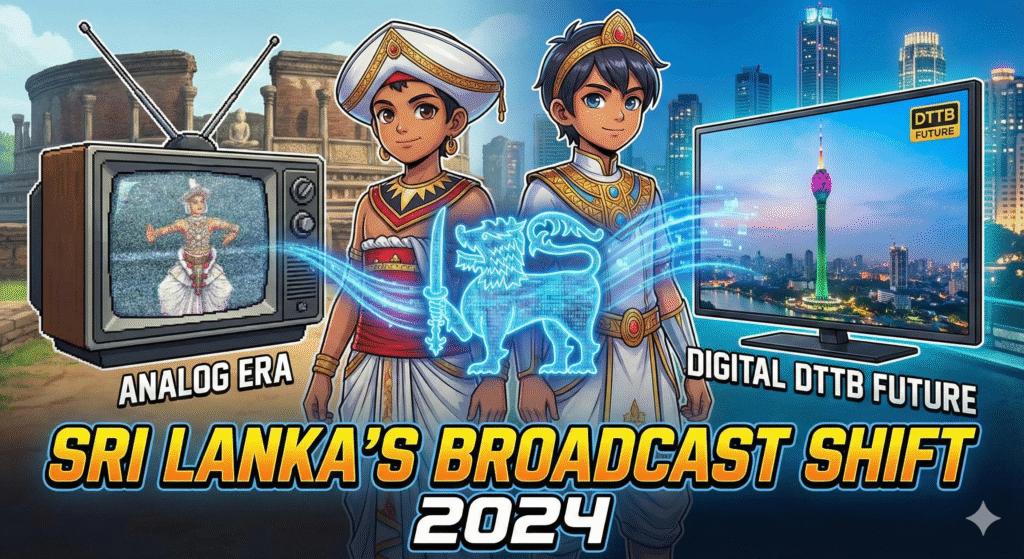
Looking at the history of electronic media in Sri Lanka, the year 2025 marks a decisive turning point. Analog television broadcasting technology, which has provided the foundation for entertainment and information in the country for over four decades, is reaching its end. With the policy decision taken by the government on November 25, 2025, steps have been taken to completely halt the issuance of new Terrestrial Analogue Television Licenses.¹ This decision is not merely a technical change; it is the beginning of a complex process that will have a broad impact on Sri Lanka’s communication infrastructure, economy, and social behavior patterns.
The chronicle of television in Sri Lanka began with the launch of the Independent Television Network (ITN) in 1979 and became a major state-sponsored communication medium with the establishment of the Sri Lanka Rupavahini Corporation (SLRC) in 1982.³ Since then, the broadcasting sector has operated based on primary analog technology. However, in the face of rapid global digitalization, maintaining traditional analog methods has become technically inefficient and economically disadvantageous. This report provides an in-depth analysis of the advent of Digital Terrestrial Television Broadcasting (DTTB) in Sri Lanka, the technical factors underlying it, the selection of the ISDB-T standard, and how this transition will affect the country’s future.
2. The New 2025 State Policy and Legal Background of Digitalization
2.1 Suspension of Analog Licenses
According to the decision taken by the Cabinet on November 25, 2025, no new terrestrial analog television licenses will be issued henceforth.¹ This decision was implemented as a joint proposal submitted by the Minister of Mass Media and the Minister of Digital Economy (the President).² The primary objective is to establish a Single Unified Digital Platform at the national level, replacing the currently fragmented and scattered analog transmission systems.
Currently, there are about 24 television channels operating in Sri Lanka, controlled by 16 entities. These institutions have long used approximately 46 different transmission centers for analog broadcasting.⁴ The government has identified that this method utilizes valuable Radio Frequency Spectrum inefficiently. Due to the nature of analog technology, only one channel can be broadcast within one frequency. However, shifting to digital technology allows these limitations to be overcome.
2.2 Transition Roadmap
This transformation cannot happen overnight. It is a long-term project consisting of several phases:
3. Technical Analysis: The Difference Between Analog and Digital
- April 2025: Signing of engineering consultancy agreements and official project launch.⁵
- 2025 – 2029: Infrastructure development. This includes the construction of digital transmission towers, modernization of existing towers, and the establishment of digital studios.¹
- 2029: Completion of the island-wide digital broadcasting network.¹
- 2029 – 2031 (Simulcast Period): A “Simultaneous Broadcast” period where both digital and analog systems operate concurrently. This is a grace period for consumers to adapt to the new technology and purchase necessary equipment (Set-Top Boxes).¹
- 2031 (Analog Switch-Off – ASO): Complete cessation of analog broadcasting. Thereafter, television can only be viewed via digital technology.¹
A common question is, “Why should we switch to digital?” This is not just a question of image quality, but a profound technical change based on physics and telecommunication engineering.
3.1 Signal Processing & Transmission
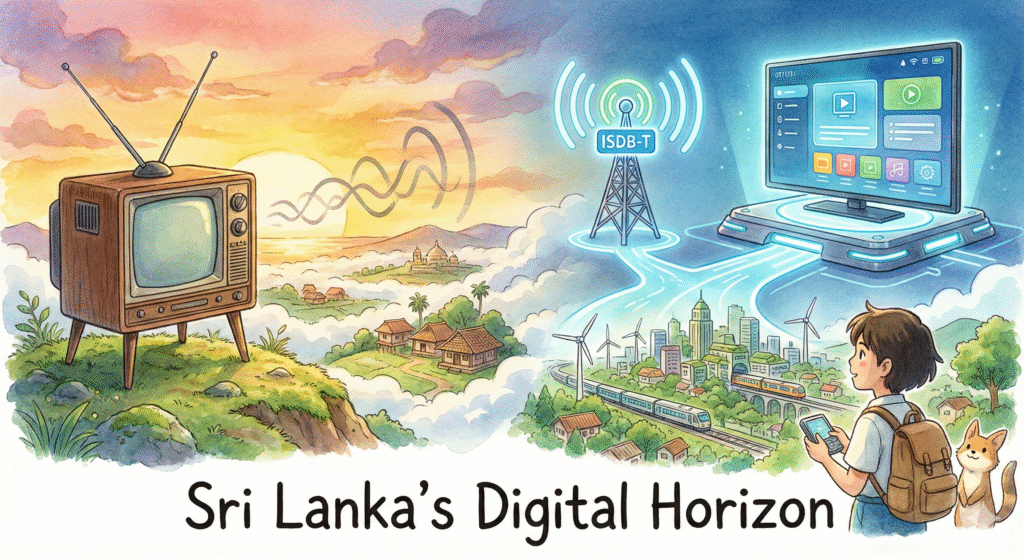
- Analog Technology: In analog TV broadcasting, video and audio are transmitted as Continuous Waves. Amplitude Modulation (AM) is used for video, and Frequency Modulation (FM) for audio. These waves can easily be distorted by obstacles like lightning, electrical equipment, and buildings (Noise & Interference) as they travel through the atmosphere.
- Weakness: As distance increases, signal strength decreases, resulting in a “Snowy” appearance or “Ghosting” (double images).⁸
- Digital Technology (DTTB): In digital broadcasting, video and audio are first converted into binary data (‘0’ and ‘1’). This data is then compressed (e.g., MPEG-4 AVC/H.264) and broadcast.
- The Cliff Effect: When a receiver picks up a digital signal, it either provides a 100% clear image or no image at all. There is no gradual blurring like in analog. If the signal is above a certain Threshold, the viewer receives studio-quality visuals.⁹
3.2 Spectrum Efficiency & Multiplexing
This is the most significant advantage of digitalization.
- Analog: Only one TV channel can be transmitted using one UHF channel (e.g., an 8 MHz wide frequency band).¹⁰
- Digital: Using Multiplexing technology, 8-10 Standard Definition (SD) channels or 3-4 High Definition (HD) channels can be broadcast simultaneously within that same 8 MHz band.⁶ This is akin to turning a single-lane road into a multi-lane highway capable of carrying multiple vehicles at once.
3.3 Technical Comparison Table
| Technical Aspect | Analog Broadcasting (Analog TV) | Digital Broadcasting (Digital TV / ISDB-T) |
| Signal Form | Continuous Wave | Binary Data Codes (‘0’ & ‘1’) |
| Frequency Use | 1 Frequency = 1 Channel | 1 Frequency = 8-12 Channels (Multiplex) |
| Image Quality | Varies with distance (Snow, Ghosting) | Very High (HD/4K). Interference-free. |
| Audio Quality | Mono or Stereo | Digital Stereo, 5.1 Surround Sound |
| Data Services | Teletext (Very limited) | EPG, Interactive Services, Datacasting |
| Compression | Not used | Uses MPEG-2, MPEG-4 (H.264) |
| Mobile Services | Not supported | Supported via One-Seg technology |
| Emergency Warnings | None | Automatically activated via EWBS |
Spectrum Efficiency
Global Standards
4. ISDB-T: The Japanese Standard Chosen by Sri Lanka
There are four main standards for digital TV broadcasting globally:
- DVB-T/T2 (European): Used in Europe, Africa, Australia, and much of Asia (including India).¹²
- ISDB-T (Japanese): Used in Japan, Brazil, Philippines, Maldives, and South America.¹³
- ATSC (American): Used in North America and South Korea.
- DTMB (Chinese): Used in China.¹⁰
Although initial studies around 2010 suggested the European DVB-T2 system for Sri Lanka¹⁴, the government officially selected the Japanese ISDB-T (Integrated Services Digital Broadcasting-Terrestrial) system in 2014.¹³ It is important to examine the reasons behind this decision.
4.1 Emergency Warning Broadcast System (EWBS)
A compelling factor for choosing ISDB-T was its integrated EWBS facility. Sri Lanka is a country frequently facing natural disasters like tsunamis, floods, and landslides. The ISDB-T system can display warning messages on the screen for viewers watching TV during a disaster. More importantly, even if the TV is in ‘Stand-by’ mode (plugged in but turned off), this technology can automatically wake the TV up to deliver the warning signal.¹⁶ This is a critical technical tool regarding life safety.¹⁸
4.2 Mobile Reception (One-Seg)
Another unique feature of ISDB-T is that it divides the frequency band into 13 segments. One of these segments (One-Seg) is dedicated to transmitting TV data to mobile phones, tablets, and small screens in vehicles (Car Navigation Systems).¹³ While other technologies like DVB-T may suffer signal drops in high-speed vehicles, ISDB-T has successfully overcome this challenge. This is why watching TV while commuting on trains and buses is common in Japan.¹⁷
4.3 Data Casting
Beyond standard TV programs, this technology allows text, weather reports, traffic information, and educational data to be displayed on the TV screen. This acts as a powerful medium to provide information to people in rural areas with limited internet access.¹⁵
Key Benefits of ISDB-T
Emergency Warnings
Mobile TV
Data Casting
5. Implementation and International Cooperation (JICA Project)
Sri Lanka’s Digital TV Project (DTTB Project) is implemented with the full sponsorship and cooperation of the Japanese government.
5.1 Financial Allocation and Loans
For this massive project, the Japan International Cooperation Agency (JICA) has provided a concessionary loan of 13.717 billion Japanese Yen (approximately USD 90-100 million).¹⁷ This loan is utilized for building the digital transmission network, constructing towers, and purchasing necessary technical equipment.
5.2 Infrastructure Development
As part of the project, a state-of-the-art 4K Digital Studio Complex is to be constructed at the SLRC premises in Colombo.²¹ Additionally, plans are in place to provide island-wide coverage via major transmission centers like the Lotus Tower in Colombo, Pidurutalagala, and Kokavil. Notably, to reduce costs, the decision was made to utilize existing towers owned by telecommunications and defense sectors instead of building a large number of new towers.²² This will save the government a significant amount of capital.
6. Global Context: Experiences from Other Countries
Sri Lanka is entering digitalization years after many countries have completed the process. Their experiences offer valuable lessons.
6.1 Japan (Source of ISDB-T)
Japan completely ceased analog broadcasting in July 2011 (excluding earthquake-affected areas). Their experience showed that educating consumers and providing necessary converters for old TVs was crucial. They successfully utilize the EWBS system for earthquake and tsunami warnings.²³
6.2 Maldives (Regional Pioneer)
Our neighbor, the Maldives, was the first country in South Asia to embrace ISDB-T technology in 2011. Instead of Japan’s standard 6 MHz bandwidth, they use an ISDB-T version with an 8 MHz bandwidth to match the European channel plan.²⁴ This allows them, as a small island nation, to use their limited frequency range with maximum efficiency. Technical analysts suggest Sri Lanka is likely to use a similar 8 MHz system.
6.3 India and Nepal
Both India and Nepal selected the European DVB-T2 technology.¹² A large country like India chose DVB-T2 due to ties with the European market and equipment availability. However, Sri Lanka deviating from the regional trend to choose Japanese ISDB-T is a specific decision based on the country’s geography and disaster management needs.
7. Economic and Social Impact Analysis
7.1 Digital Dividend and 5G
The greatest economic benefit of digitalization comes not from broadcasting, but from the telecommunications sector. The 700 MHz frequency band, currently used for analog TV, is considered a “Golden Band.” Once TV channels are compressed into a smaller range via digitalization, this 700 MHz band becomes free. This is known as the “Digital Dividend.” The Telecommunications Regulatory Commission (TRCSL) is expected to auction or allocate this freed spectrum for 5G mobile services and high-speed internet.²² This is an ideal opportunity to provide low-cost internet facilities to rural areas.
7.2 Impact on the Consumer and Costs
While digitalization brings technical benefits, it poses a financial challenge to the consumer.
- Set-Top Box (STB) Cost: Owners of old CRT TVs or LCD TVs without digital tuners will have to buy a Set-Top Box. The market price may range between Rs. 3,000 – 4,000.²⁸ Since this could be a burden for low-income families, it is essential for the government to implement a subsidy scheme or a free distribution program. TRCSL reports indicate that attention has been paid to providing relief for low-income families.²⁹
- Quality: The main benefit to the viewer is receiving clear HD images and superior sound instead of noisy visuals. Additionally, the convenience of viewing program details (EPG) on-screen is available.
7.3 Local Channels and Broadcasters
Channel owners who previously maintained their own transmission towers will have to connect to a Common Infrastructure with digitalization. This will lead to a significant reduction in their operational costs (Electricity & Maintenance).²² Furthermore, since multiple channels can be maintained within one frequency, new opportunities open up for local media institutions to start additional channels like “Sports Channels” or “Kids Channels.”³⁰
Are you ready?
The analog signal will eventually be turned off. Use this tool to check your equipment.
Equipment Check
What type of TV do you have?
Did you buy it after 2018?
8. Challenges and Risk Management
Although digitalization looks like a beautiful dream, serious challenges exist in making it a reality.
- Lack of Public Awareness: Many are unaware that digitalization will occur by 2029. Without proper publicity, there is a risk that half of the country’s televisions will go blank on the day analog broadcasting stops (2031).
- E-waste Management: A large amount of electronic waste may accumulate as old TVs are discarded or STBs are purchased. A national policy is needed for this.
- Technical Issues: The unavailability of ISDB-T equipment in the market could be an issue (mostly DVB-T2 equipment is available). The government must intervene to encourage the importation of equipment with the correct standards.²⁹
9. Conclusion
The decision taken by the Sri Lankan government in 2025 is a giant leap for the local media sector. Moving from the analog era to the Digital Migration era is not just about clearing up the picture on the TV screen. It is an opening of doors to 5G technology; a tool that saves lives in disaster management; and an essential component of the journey toward an Information Society.
The selection of Japanese ISDB-T technology appears to be a very correct technical decision due to its disaster warning and mobile broadcasting capabilities. However, the success of this project depends not on the technology, but on how it is implemented. In particular, supporting low-income populations to access this technology and adapting local TV channels to this new environment is a major responsibility of the government. By the year 2031, it can be expected that analog waves will fade from the Sri Lankan sky, and new knowledge and entertainment will flow through digital waves.
- Sri Lanka Officially Halts New Analog TV Licenses to Accelerate Digital Broadcasting, accessed November 27, 2025, https://www.portaldoholanda.com.br/esportes/brasileirao-35-rodada-jogos-e-classificacao?s-news-12672086-2025-11-26-sri-lanka-halts-new-analog-tv-licenses-to-promote-digital-broadcasting
- Sri Lanka Decides To Pull The Plug on Analogue TV, accessed November 27, 2025, https://www.newsfirst.lk/2025/11/25/sri-lanka-decides-to-pull-the-plug-on-analogue-tv
- Switching to Digital Television: A Bumpy Road For Sri Lanka? – Echelon.lk, accessed November 27, 2025, https://echelon.lk/switching-to-digital-television-a-bumpy-road-for-sri-lanka/
- Government Halts New Analogue TV Licences as Country Moves Toward Digital Broadcast Era – Lanka News Web, accessed November 27, 2025, https://lankanewsweb.net/archives/148237/government-halts-new-analogue-tv-licences-as-country-moves-toward-digital-broadcast-era/
- Sri Lanka Signs Landmark Agreement to Launch Digital Terrestrial Television Broadcasting, accessed November 27, 2025, https://lankanewsweb.net/archives/71760/sri-lanka-signs-landmark-agreement-to-launch-digital-terrestrial-television-broadcasting/
- The Digital Terrestrial Television Broadcasting (DTTB) | Sri Lanka’s journey towards digital transformation., accessed November 27, 2025, https://dttb.gov.lk/
- Sri Lanka Decides To Pull The Plug on Analogue TV, accessed November 27, 2025, https://english.newsfirst.lk/2025/11/25/sri-lanka-decides-to-pull-the-plug-on-analogue-tv
- What is the Difference Between an Analog and a Digital Antenna?, accessed November 27, 2025, https://www.antennaexperts.co/blog/what-is-the-difference-between-an-analog-and-a-digital-antenna
- Was analog tv really that bad? I’ve been recording my favorite shows using a DTV box and it’s such a pain in the ass. : r/VHS – Reddit, accessed November 27, 2025, https://www.reddit.com/r/VHS/comments/1cnyzam/was_analog_tv_really_that_bad_ive_been_recording/
- Digital terrestrial television – Wikipedia, accessed November 27, 2025, https://en.wikipedia.org/wiki/Digital_terrestrial_television
- Sri Lanka to Switch to Digital TV – What? – ReadMe, accessed November 27, 2025, https://readme.lk/sri-lanka-switch-digital-tv-what/
- DVB-T – Wikipedia, accessed November 27, 2025, https://en.wikipedia.org/wiki/DVB-T
- ISDB – Wikipedia, accessed November 27, 2025, https://en.wikipedia.org/wiki/ISDB
- Roadmap for the Transition from Analogue to Digital Terrestrial Television Broadcasting in Sri Lanka – ITU, accessed November 27, 2025, https://www.itu.int/ITU-D/tech/digital_broadcasting/project-dbasiapacific/Roadmaps/db_asp_roadmap_SriLanka.pdf
- Sri Lanka to digitalize TV broadcasting, accessed November 27, 2025, https://mfa.gov.lk/en/sri-lanka-to-digitalize-tv-broadcasting/
- Implementation of Emergency Warning Broadcasting System in the Asia Pacific Region – ITU, accessed November 27, 2025, https://www.itu.int/en/ITU-D/Emergency-Telecommunications/Documents/Thailand_2006/final1/Session%209/SESSION%209%20[NHK]%20Dr%20Kazuyoshi%20SHOGEN.pdf
- Special Assistance for Project Implementation of Digitalization of Terrestrial Television Broadcasting Project in the Democratic Socialist Republic of Sri Lanka Final, accessed November 27, 2025, https://openjicareport.jica.go.jp/pdf/12319398.pdf
- Sri Lanka to digitalize TV broadcasting, accessed November 27, 2025, https://mfa.gov.lk/tam/sri-lanka-to-digitalize-tv-broadcasting/
- Handover Ceremony for the Technical Standards prepared by Japan on Digital Terrestrial Television Broadcasting (DTTB) project in Sri Lanka | Where We Work – JICA, accessed November 27, 2025, https://www.jica.go.jp/english/overseas/srilanka/information/press/2023/20230712.html
- Overview of TV Digitalization in Sri Lanka – ITU, accessed November 27, 2025, https://www.itu.int/en/ITU-T/Workshops-and-Seminars/2023/0511/Documents/1_L.%20Ganeshamoorthy.pdf
- Sri Lanka Embarks on Digital Television Era with Launch of DTTB Project, accessed November 27, 2025, https://media.gov.lk/media-gallery/latest-news/3388-sri-lanka-embarks-on-digital-television-era-with-launch-of-dttb-project
- Terrestrial Digital TV set to boost digital economy | Print Edition – Sunday Times, accessed November 27, 2025, https://www.sundaytimes.lk/250706/business-times/terrestrial-digital-tv-set-to-boost-digital-economy-603032.html
- ISDB-T Broadcasting Technology Seminar Held in Sri Lanka – DiBEG, accessed November 27, 2025, https://www.dibeg.org/news/2016/1612_isdb-t_seminar_held_in_sri_lanka/
- accessed November 27, 2025, https://en.wikipedia.org/wiki/ISDB#:~:text=On%20November%2015%2C%202011%2C%20the,channel%20bandwidth%20is%208%20MHz.
- Maldives ISDB-T: Adopted Japanese Digital TV standard – iVcan.com, accessed November 27, 2025, https://ivcan.com/maldives-isdb-t-adopted-japanese-digital-tv-standard/
- Roadmap for the Transition from Analogue to Digital Terrestrial Television in Nepal – ITU, accessed November 27, 2025, https://www.itu.int/pub/D-PREF-THEM.10
- DTTB project launch will enhance television broadcasting sector – Minister, accessed November 27, 2025, https://media.gov.lk/media-gallery/latest-news/3390-dttb-project-launch-will-enhance-television-broadcasting-sector-minister
- LFJNET (Upgraded Version) ISDB-T Digital Terrestrial Sri Lanka | Ubuy, accessed November 27, 2025, https://www.ubuy.com.lk/en/product/2XZWD6RY-lfjnet-upgraded-version-isdb-t-digital-terrestrial-converter-tv-box-receiver-1080p-us-plug
- empowering sri lanka’s digitalization & eradicating the digital divide – Telecommunications Regulatory Commission, accessed November 27, 2025, http://www.trc.gov.lk/content/files/reports/AR2020_E.pdf
- State of Digital TV in Sri Lanka. Most of us in Sri Lanka hardly talk… | by Jay Mayu | Medium, accessed November 27, 2025, https://medium.com/@mayooresan/state-of-digital-tv-in-sri-lanka-1b03b29868b2