
The universe is overrun with dark matter, outweighing the ordinary stuff that stars and planets are made of five-to-one. But some corners of the cosmos are more dominated by the invisible substance than others.
Using the stalwart Hubble Space Telescope, a team of astronomers have found a galaxy 300 million light away that appears to be made of at least 99.9 percent dark matter — so much that the galaxy is barely visible at all, they report in a new study published in The Astrophysical Journal Letters.
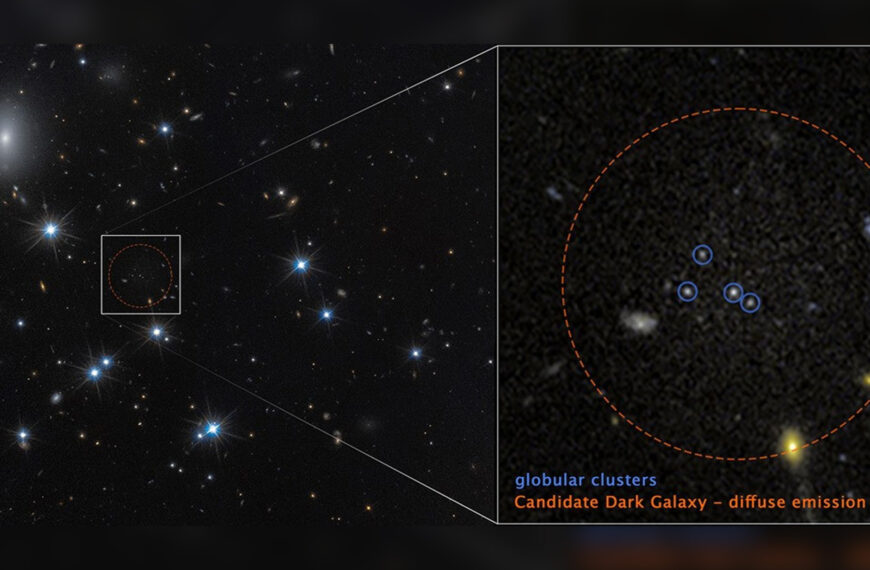
The tenebrous realm, dubbed CDG-2, could be one of the most dark matter heavy galaxies ever found, and a compelling candidate for elusive and yet hypothetical “dark galaxies” that astronomers have been searching for for decades, which are thought to contain vanishingly few, if any, stars.
“To be technically correct, CDG-2 is an almost-dark galaxy,” explained study lead author Dayi Li, an astrophysicist at the University of Toronto, in an interview with CNN; it belongs to a broader class of objects called low surface brightness galaxies. “But the importance of CDG-2 is that it nudges us much closer to getting to that truly dark regime, while previously we did not think a galaxy this faint could exist.”
How do you find something that’s composed almost entirely of invisible material? Using the Hubble, another space telescope from the European Space Agency called Euclid, and the Subaru Telescope in Hawaii, the astronomers searched for bright spots called globular clusters: tightly packed, spherical conglomerations of old stars that are “basically the relics of the first generation of star formation,” as Li described it. In an essentially empty realm, dark matter is what helps keep these shiny stars glued together, the thinking goes.
With the three telescopes, the team pinpointed four globular clusters in one of the biggest and brightest objects in the universe known as the Perseus Cluster, a dense grouping of thousands of galaxies trapped in a cloud of superheated gas. In such a dense environment, a dark galaxy could arise when the older galaxies pull away star forming material from a younger one, essentially stunting its development. This hunch was borne out when the astronomers found that, even though the globular clusters were languishing in an empty stretch of Perseus, they were surrounded by a halo of glowing matter — a telltale sign of a galaxy.
“The material that this galaxy needed to continue to form stars was no longer there, so it was left with basically just a dark matter halo and the four globular clusters,” Li told CNN.
Other astronomers were enthusiastic about the findings. Dark or nearly dark galaxies could provide a pristine look at the behavior of dark matter and a “cleaner probe of dark matter physics,” Neal Dalal, researcher at the Perimeter Institute for Theoretical Physics in Waterloo, told CNN. In typical galaxies like the Milky Way, the “stars and gas can have a significant impact on the distribution of dark matter, making it difficult to disentangle the effects of ordinary matter from the effects of dark matter.”
More on space: James Webb Takes Long, Hard Look Inside Uranus
The post Hubble Spots Bizarre Galaxy That Appears to Be 99.9 Percent Dark Matter appeared first on Futurism.