Some dedicate their lives to science. Others, like Georgia Tech student Chris Zuo, give their bodies.
A bizarre three-year study run by Georgia Tech engineering and biology professor David Hu sought to identify how mosquitoes choose their prey. As explained by Hu in the Conversation, mosquitoes are the world’s most dangerous animal, causing over 700,000 deaths every year by spreading deadly disease like Malaria.
In the initial experiment, Zuo stood in as bait in a chamber full of 100 hangry skeeters. Though he had a mesh suit, it failed to stop the bugs from reaching his skin, causing him to suffer what Hu calls a “full-body massacre.”
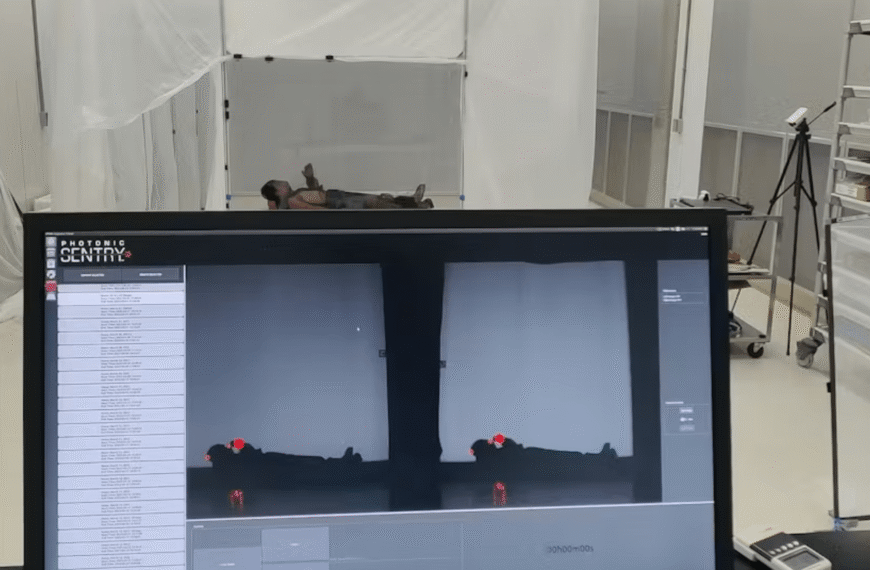
As the trials went on, Zuo became a graduate student. He switched out of the failed mesh suit to a basic long-sleeved shirt, washed with unscented detergent, as well as gloves and a face mask. He and a fellow student, Soohwan Kim, were then tasked with standing in the chamber while a photonic sentry camera — courtesy of the US Centers for Disease Control and Prevention — tracked the mosquito flight paths at 100 frames per second.
The result of these torture trials, Hu writes, is data from 20 million individual skeeter flights, or “more mosquito flight data than had previously been measured in human history.”
Armed with the glut of raw data from years of careful trial and error, the Georgia Tech researchers found that mosquitos change their flight behaviors based on the kind of target present in their environment. With nothing to attack, mosquitos simply wander aimlessly, flittering about at random. A purely visual target, like a styrofoam ball on a stick, causes a fly-by, while a target emitting CO2 — like Zuo, for instance — causes a sort of double-take maneuver.
The combination of a visual target and CO2 emission that Zuo presents as a warm-blooded organism, however, seemed to whip the mosquitoes into a frenzied orbit.
Over the three-year study period, Hu and his team were able to successfully predict areas of Zuo’s body that were particularly prone to mosquito attacks, which Hu framed as the “first step toward outsmarting them.”
While there’s plenty more work to do in the field of human-mosquito relations, this biting-edge research is hopefully the first of many to help aid humanity in our ongoing war against the blood-sucking pests.
More on bugs: Bugs Fed Microplastics Grow to Ludicrous Size
The post Scientists Recruit Undergrad to Step Into Room Filled With Ravenous Mosquitoes for “Full-Body Massacre” appeared first on Futurism.