
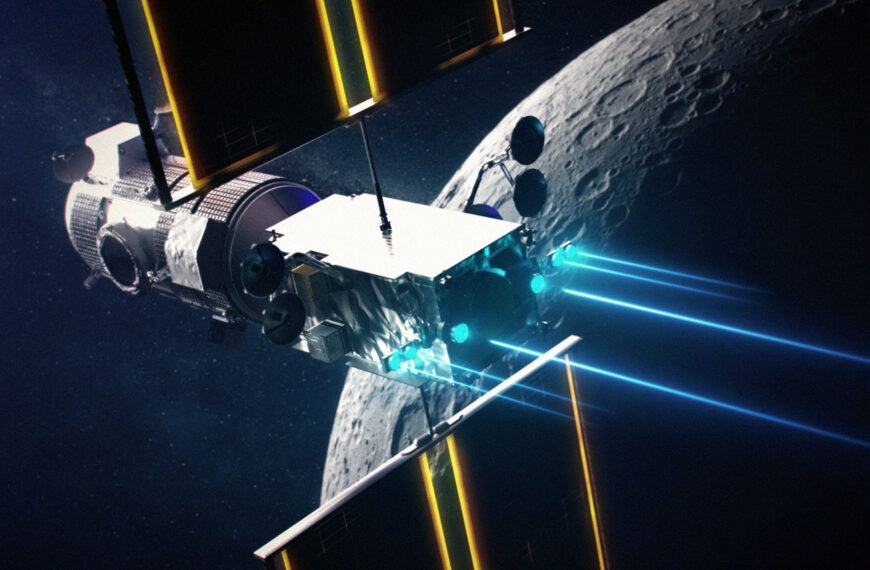
NASA’s plans for a Moon base have been capturing headlines lately — but today it’s putting Mars back in the crosshairs with a first-of-its-kind nuclear mission it says will launch by the end of 2028.
It’ll be the “first nuclear powered interplanetary spacecraft,” according to a NASA announcement, dubbed “Space Reactor‑1 Freedom.”
The goal is to demonstrate “advanced nuclear electric propulsion in deep space,” a concept has remained highly elusive, despite the theoretical advantages of high energy efficiency and the ability to cover vast distances.
“Nuclear electric propulsion provides an extraordinary capability for efficient mass transport in deep space and enables high power missions beyond Jupiter where solar arrays are not effective,” NASA wrote.
Once it reaches the Red Planet, the SR-1 Freedom mission will deploy three helicopters roughly the same size as NASA’s groundbreaking Ingenuity, to “continue exploring” the Red Planet.
The agency has high hopes for its nuclear powered mission, claiming that it “will establish flight heritage nuclear hardware, set regulatory and launch precedent, and activate the industrial base for future fission power systems across propulsion, surface, and long‑duration missions.”
Interestingly, the mission will repurpose the propulsion and power element (PPE) from its Lunar Gateway, a proposed space station in the Moon’s orbit, which has officially been put on hold by the agency.
The idea behind using nuclear fission to reach the deserted planet has been around since at least the 1950s. But turning the flashy concept into reality could prove challenging. For one, NASA will need to source enriched uranium to give its rocket the best chance of success, which is easier said than done.
Put simply, there are two core types of nuclear propulsion being developed. Nuclear thermal propulsion (NTP) involves using a fission reactor using uranium to heat up extremely cold liquid propellant, such as a store of hydrogen, and releasing the hot gas out of a nuzzle to generate thrust. A nuclear electric rocket, like NASA’s SR-1 Freedom mission also involves splitting atoms using a reactor, but using the power to drive an ion thruster or other method of electric propulsion instead.
At least on paper, both systems are more efficient than chemical rockets in terms of specific impulse, or thrust, per amount of propellant. They can also provide propulsion where solar arrays are no longer effective given the distance to the Sun.
The momentum behind the idea of cutting a journey to Mars in half with the help of nuclear-powered rockets is palpable. NASA signed a partnership with the Defense Advanced Research Projects Agency (DARPA) and Lockheed Martin in 2023 to design, build, and test a nuclear propulsion system as part of an ambitious program called the Demonstration Rocket for Agile Cislunar Operations (DRACO).
However, DARPA canceled the project in June 2025 after a short internal review and concluding that theoretical performance gains may be less than anticipated.
Officials also noted that the cost of launch continues to come down in large part thanks to Elon Musk’s SpaceX.
“When DRACO was originally conceived of, that was pre- the precipitous decrease in launch costs that has been driven largely by SpaceX capabilities and the continued decrease that Starship offers if we can get it operational,” DARPA deputy director Rob McHenry said in a statement at the time.
“And it was also based on analysis at the time that showed that nuclear thermal was likely to be the optimal solution for a set of national security related admissions, as well as solar system exploration,” he added. “And over the execution of that program, both of those assumptions started to get weaker and weaker.”
More on nuclear propulsion: Startup Says Its Nuclear Fusion Rocket Could Cut Time to Mars in Half
The post NASA Announces Nuclear Mission to Mars by 2028 appeared first on Futurism.