
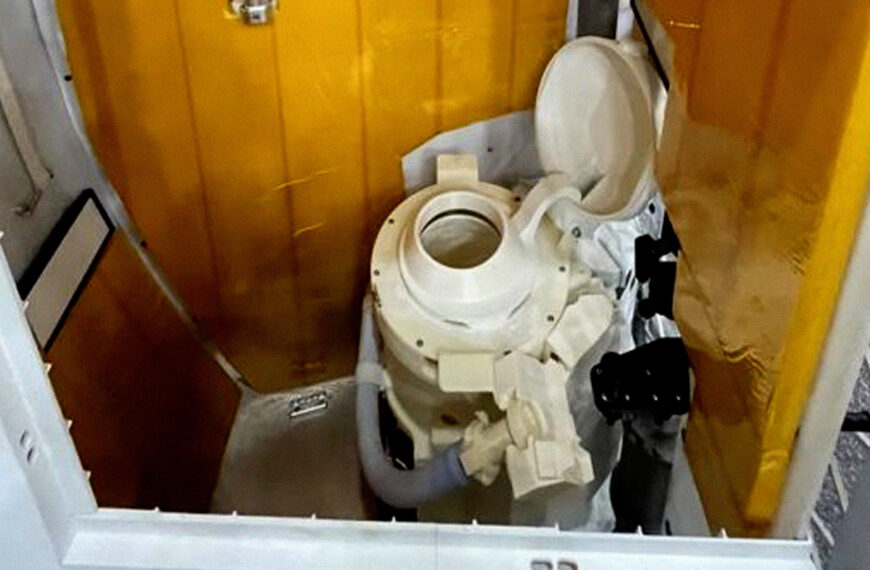
As we continue to feast on breathtaking images of the Moon’s far side taken by the crew of NASA’s Artemis 2 mission, it bears repeating that it took plenty of hardship to get to this point.
Managing human waste, in particular, has seemingly proven as difficult as ever. The culprit: a newfangled $30 million space toilet, dubbed the Universal Waste Management System (UWMS) and installed on board NASA’s Orion spacecraft.
It all started within hours of launch last week, when the crew reported that the toilet’s fan had jammed. It turned out that they hadn’t added enough water to prime the pump. After NASA astronaut Christina Koch topped off the water level, the system sprang into action.
“I’m proud to call myself the space plumber,” she later told mission control. “We were all breathing a sigh of relief when it turned out to be just fine.”
Days later, the toilet broke down for a second time. This time, the tube meant to vent pee to the outside of the spacecraft had clogged due to “frozen urine.” Rotating the Orion capsule to expose the line to the Sun and using vent heaters to melt away the ice once again made the commode usable.
On Monday, roughly five days into their mission, the toilet became off-limits for at least the third time.
“We just wanted to let you know that toilet right now is no go for use as we stick with the predetermined limit for now,” Jenni Gibbons, capsule communicator (CAPCOM) at Mission Control, told the astronauts around 4 pm Eastern time. “All crew members, please use CCUs.”
Gibbons was likely referring to the wastewater tank, which may have filled up to the point where the toilet became no longer usable due to ice buildup significantly slowing down the amount of urine it could vent to the outside.
The Collapsible Contingency Urinal is an emergency device designed to allow astronauts to relieve themselves in case their space toilet were to malfunction. The device, a tube measuring roughly two feet in length, is “essentially an open container (reusable, sealable, and drainable) that controls the urine-air interface using capillary forces,” as NASA astronaut Donald Pettit explained in a recent Instagram post.
“When you are in cislunar space with a broken toilet, you need contingencies and the CCU replaces the need for about 25 pounds of diapers,” Pettit wrote.
The crew of four will be taking their solid waste back to Earth sealed inside plastic bags that line the toilet’s seat.
Despite being several hundred thousand miles away, the crew’s toilet problems hit close to home.
“I think the fixation on the toilet is kind of human nature,” mission management team chair John Honeycutt told reporters Saturday evening after the toilet broke down for a sceond time. “Everybody knows how important that is to us here on Earth. And it’s harder to manage in space.”
More on toilet troubles: Moon Astronauts Forced to Do It in Bags as “Burning Odor” Emanates From Toilet
The post The Moon Spacecraft’s $30 Million Toilet Has Been a Bit of a Disaster appeared first on Futurism.