
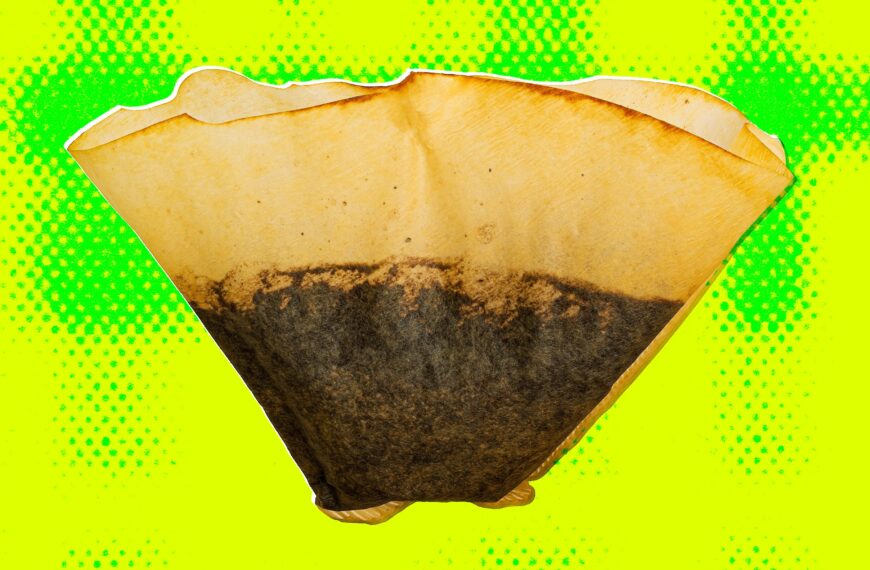
How long does it take to convert soggy coffee grounds into a highly efficient fuel source? About as long as it takes to brew a fresh pot of java, researchers say.
According to a press release from South Korea’s National Research Council of Science and Technology, a team of researchers at the Korea Institute of Geoscience and Mineral Resources (KIGAM) have developed a method to convert spent coffee waste into high-quality charcoal, known as biochar.
While that’s a feat in and of itself, the kicker is the method’s blistering speed: it takes just 90 seconds from start to finish, with no drawn-out drying process or oil separation required. According to the release, the new technique solves a major issue in extracting the latent energy potential of spent coffee beans.
Though we generate anywhere from 8 to 10 million tons of high-energy coffee waste a year, the vast majority of that ends up occupying space in landfills. While other coffee recycling techniques do exist, the high moisture content of spent beans has made energy extraction a massive chore, preventing the kind of efforts that could give bean juice a second life at scale.
To get around this, the KIGAM team developed a technique known as Flame Plasma Pyrolysis (FPP), in which coffee waste is put under immense pressure using plasma as hot as 1,652 degrees Fahrenheit. Basically, the method superheats the moisture trapped within the beans to kick off hundreds of microscopic explosions, leading to the creation of tiny, porous structures, and reducing the total biomass by as much as 83.3 percent.
By the end of the process, the researchers were left with a substance “comparable to that of anthracite coal.” According to the researchers, the resulting biochar makes for great fuel, and also has applications as carbon material in industrial and environmental settings.
On top of cutting down the processing time to just minutes — previous methods took hours — they say the FPP process cuts down on pollutants like smoke and tar during heating.
“This technology presents a new paradigm in which waste is no longer viewed as a disposal problem but as a valuable energy resource,” the study’s lead author, Taejun Park, said in the press release. “We plan to expand the technology to various types of high-moisture organic waste and further optimize the process for industrial-scale commercialization.”
More on renewable energy: Solar Just Produced More Electricity Than Coal for the First Time in the History of the United States
The post Scientists Say New Method Turns Coffee Grounds Into High-Potency Renewable Fuel appeared first on Futurism.