
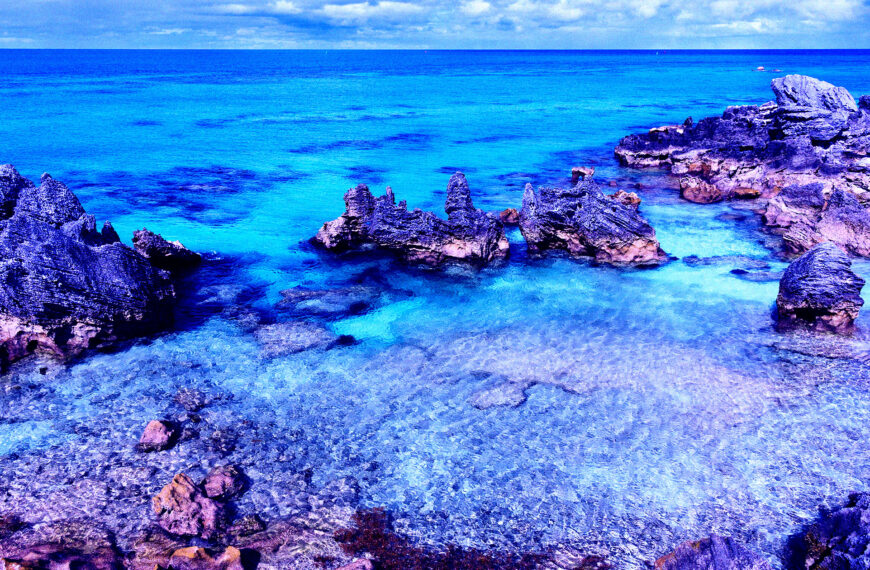
The Bermuda Triangle, a loosely defined region bounded by Bermuda, the Bahamas, and Puerto Rico, has been the subject of countless urban legends, from mysteriously disappearing ships to entire World War 2 squadrons. Outlandish theories have suggested that technology left over from the mythical lost city of Atlantis, lurking beneath the triangle, could be to blame.
But instead of the remains of a fabled city, geologists have made an entirely different discovery while examining the archipelago of Bermuda in the middle of the North Atlantic. As detailed in a paper published in the journal Geophysical Research Letters, Carnegie Science seismologist William Frazer and his colleague, Yale University professor of Earth and planetary sciences Jeffrey Park, say they’ve found an unexpected, 12.4-mile-thick layer of rock lurking below Bermuda’s oceanic crust.
“Typically, you have the bottom of the oceanic crust and then it would be expected to be the mantle,” Frazer told Live Science. “But in Bermuda, there is this other layer that is emplaced beneath the crust, within the tectonic plate that Bermuda sits on.”
The team suggests the massive structure may date back to the last major volcanic eruption in the area some 31 million years ago, which caused mantle rock to be injected into the crust. This rock then created a raft-like slab that raised the ocean floor by 1,640 feet, as Live Science explains.
This floating “swell” has yet to subside over tens of millions of years of volcanic inactivity, a mystery Frazer and Park set out to solve.
They analyzed seismic data collected on Bermuda to probe to a depth of about 31 miles below the island territory.
They found a “thick underplated layer of modified lithospheric mantle” that supports the Bermuda swell, and “not a hot thermal anomaly from a mantle plume,” according to their paper.
It’s a particularly intriguing finding, considering scientists believe the area was once part of the supercontinent Pangea, which formed hundreds of millions of years ago. Many other island chains in the Pacific or Indian oceans are the result of volcanic hotspots.
Frazer is now probing other islands around the world to see if other similarly unusual structures are lurking elsewhere.
“Understanding a place like Bermuda, which is an extreme location, is important to understand places that are less extreme,” he told Live Science, “and gives us a sense of what are the more normal processes that happen on Earth and what are the more extreme processes that happen.”
More on mysterious structures: Divers Intrigued by Huge Underwater Structure
The post Scientists Intrigued by Huge Structure Under Bermuda appeared first on Futurism.