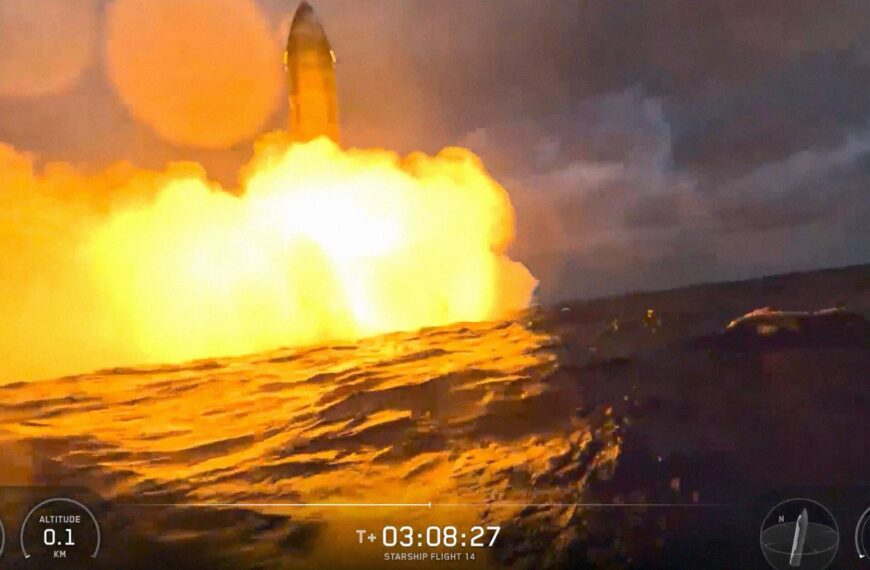
On its 14th flight test Monday, SpaceX’s Starship successfully flew into orbit for the first time, marking a huge milestone for the Elon Musk owned company.
But it didn’t stay up there long. Originally scheduled to fly around the planet six times in a mission lasting a total of ten hours, the rocket instead returned to Earth just three hours into its orbital adventure because of an engine failure. Belly-flopping on its way down, the spaceship righted itself before making a less-than-soft landing in the Pacific, exploding in a fireball moments after touchdown.
While the causes of this propulsion malfunction aren’t clear yet, experts fear that it may portend a fundamental issue with the rocket’s design, which could set back NASA’s 2028 mission, Artemis IV, in its efforts to land humans on the Moon for the first time in over half a century using the spacecraft.
The launch from SpaceX’s Starbase facility in Texas on Monday achieved most of the rocket company’s objectives, including a successful first foray into orbit. While up there, the spacecraft’s upper stage deployed a payload of 26 functioning next-gen Starlink satellites (previous tests used dummies), while its lower stage booster made a controlled splashdown in the Gulf of Mexico.
Bringing cargo to orbit is an essential part of any practical rocket’s capabilities, making this an unimpeachable milestone. But it’s a feat that comes years behind schedule; Musk originally promised that Starship would achieve satellite deployments by 2023.
A lagging schedule may continue to haunt its development. Two of the 33 Raptor engines on the Super Heavy booster failed during its flight: one on the way up, and one on the way down. And one engine failed on the Starship upper stage during its ascent, forcing the remaining engines to work harder. SpaceX, “out of an abundance of caution,” decided to forego having the upper stage continue its stint in orbit after deploying the payload and brought it home early, fearing that the spacecraft, an engine down, and with its online ones overtaxed, could flame out dangerously during a prolonged orbital flight.
That single engine failure could be significant. Dean Sladen, an aerospace engineer for Accu Components, says that the propulsion issue could be a “one-off failure of a single part,” or it could indicate a more fundamental design problem that could require overhauls “across the fleet” — which would eat into time that SpaceX simply doesn’t have, with the Artemis lunar missions looming.
“Any engine fix that holds up the next flights, including the planned attempt to catch the ship with the launch tower’s arms (after re-entry), eats into that schedule,” Sladen told Reuters.
This has commercial implications for the now-public rocket maker, too. SpaceX needs the Starship to get up and running so it can replenish its Starlink constellations — currently its only profitable operation — with the newest version of its satellites, which can’t fit into its tried and true orbital ferry, the Falcon 9 rocket.
But the “real pressure is the Moon,” Sladen said, because “NASA needs Starship for Artemis III.” Artemis III will serve as a dress rehearsal for the Moon landing by having astronauts fly around the Earth for two weeks and perform docking maneuvers in orbit. That’s slated for the summer of 2027.
The engine failure isn’t in itself disastrous. SpaceX will likely iron out the kinks. But it’s racing against the clock, and every mounting setback could culminate in a humiliating delay for the US’s space program.
More on SpaceX: SpaceX Investors Are Losing Their Minds Trying to Figure Out Why the Company’s Stock Failed to Go Up Yesterday
The post SpaceX’s Troubled Starship Test Yesterday Is Looking Ominous for NASA’s Moon Landing appeared first on Futurism.