
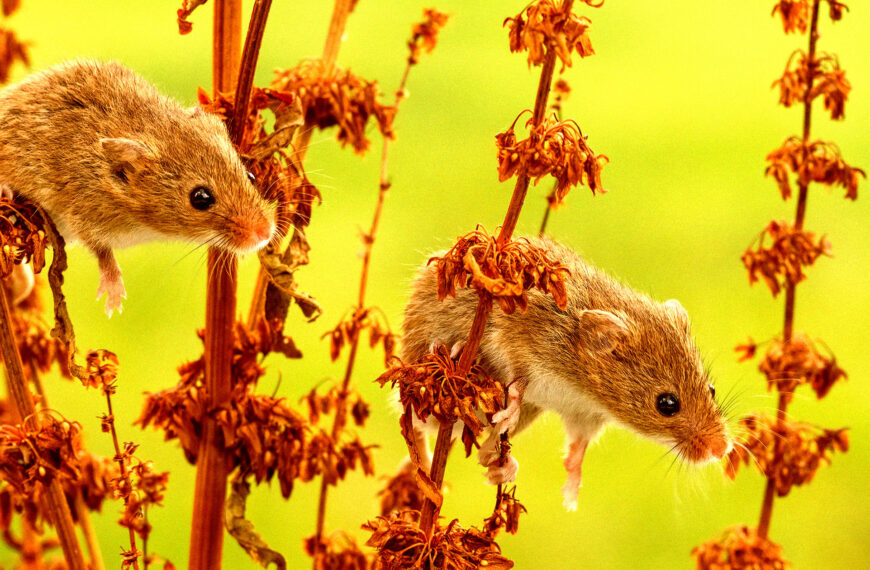
Lab mice are subjected to countless horrors during their short lives, from being injected with cancerous cells to getting exposed to microplastics or ending up dosed with cocaine.
It’s a controversial research standard that has long been criticized by animal rights activists. Even some in the scientific community argue they deserve better treatment, much like their human counterparts in clinical trials.
And things get even worse when you learn about the lives they could be living if they weren’t confined inside a lab. As detailed in a new paper published in the journal Current Biology, researchers at Cornell University found that lab mice that were released into a large, enclosed field near the institution’s campus almost immediately became less anxious — a lesson we might all learn something from.
These “rewilded” mice behaved in dramatically different ways, even when they had an established record of anxiety.
“We release the mice into these very large, enclosed fields where they can run around and touch grass and dirt for the first time in their lives,” said senior author and Cornell associate professor of neurobiology and behavior Michael Sheehan in a statement about the research.
Beyond the positive effects of having lab mice live healthier lives, scientists suggest the data gleaned from them might become more reliable and generalizable. Scientists have long debated whether we can or should apply what we learn from lab mouse-based experiments to other animals or humans, especially when it comes to health-related research.
“It’s a new approach to understanding more about how experiences shape subsequent responses to the world, and the hope is that what we learn from these mice will have more generalizability to other animals and to ourselves as well,” Sheehan added.
To gauge anxiety in the test mice, the researchers used the most commonly used technique out there, called the “elevated plus maze.” The cross-shaped maze has an open and a closed arm. Rodents with higher anxiety seek the shelter of the closed-off arm, while those with lower anxiety generally spend more time in the exposed arm.
In an experiment, the Cornell team introduced lab mice to the maze before releasing them into the field. Once they returned from their odyssey, their behavior in the maze changed significantly.
“The rewilded mice show either no fear response or a much, much weaker response,” said first author and Cornell postdoctoral researcher Matthew Zipple in the statement.
Even mice that were reintroduced several times to the maze before being rewilded reversed their anxiety after their transition to a more natural environment.
“We put them in the field for a week, and they returned to their original levels of anxiety behavior,” Zipple explained. “Living in this naturalistic environment both blocks the formation of the initial fear response, and it can reset a fear response that’s already been developed in these animals in the lab.”
The team suggests mice may learn from having a wider range of experiences, findings that echo previous studies into the psychology of humans.
“We think this change in behavior is about agency, at its core,” Zipple said. “What I mean by agency is the ability of an animal to change its experiences in an environment through its own behavior.”
The more the mice experienced, like finding their own food or escaping from predators, the more they were able to cope with adversity.
“If you experience lots of different things that happen to you every day, you have a better way to calibrate whether or not something is scary or threatening,” Sheehan said in the statement. “But if you’ve only had five experiences, you come across your sixth experience, and it’s quite different from everything you’ve done before, that’s going to invoke anxiety.”
There might even be a lesson for humans in there somewhere: that it can’t hurt to touch grass every once in a while.
“One of the things that could be causing a rise in anxiety in young people is that they’re living more sheltered lives,” Sheehan explained. “There are conversations around modernity and our own lives that are echoed in this research that make it really interesting.”
More on lab mice: Lab Mice Exposed to Microplastics Show Signs of Dementia
The post When You Hear What Happens When They Put Lab Mice in Nature, You Might Rethink Your Entire Life appeared first on Futurism.