
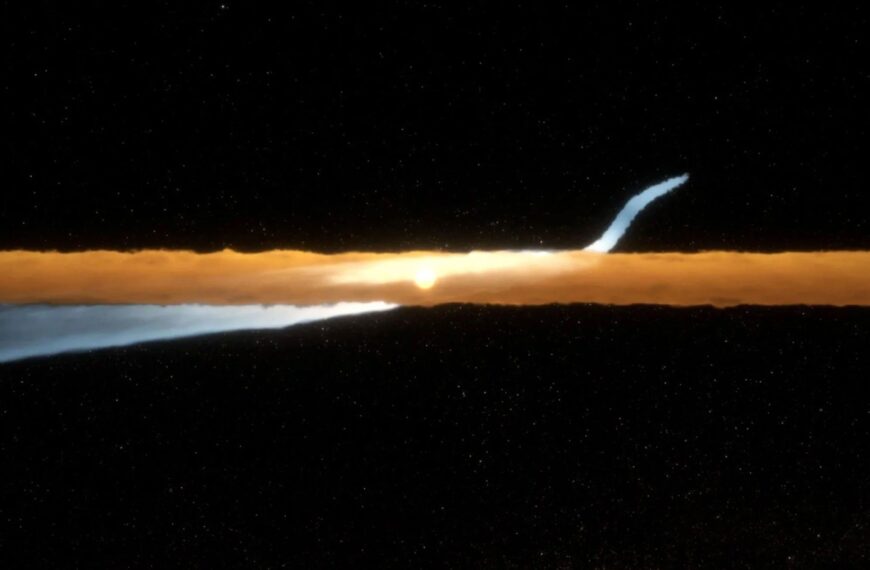
A mere 63 light-years from Earth lurks an enormous structure that spans around 1,000 astronomical units — or 93 billion miles — with the evocative nickname of “Cat’s Tail.”
The structure, believed to be largely made of dust, is located in the Beta Pictoris star system, and was first directly observed by NASA’s James Webb Space Telescope in infrared light.
Now, thanks to new images taken by the Hubble Space Telescope, we get to the see the tail in visible light as well, revealing a bizarre tail-like protrusion sticking out of the plane of a gargantuan, disk-shaped accumulation of cosmic dust.
As detailed in an article published last month in The Astrophysical Journal Letters, a team led by researchers at the University of Arizona were intrigued to get a closer look at the structure using the Hubble.
“Oddly, this feature had previously only been seen with the James Webb Space Telescope, which detects infrared light, but remained invisible at shorter wavelengths, which has puzzled the community for a while,” said research lead and University of Arizona doctoral student Arin Avsar in a statement. “We think the Cat’s Tail has eluded our observations in visible light until now because of what it’s made of.”
“It consists almost entirely of we call organic refractory material, which is heavily carbon-based,” he added. “These long chains of carbon atoms absorb visible light, so they’re quite black.”
Scientists believe the Cat’s Tail is the result of large, Pluto-like planetary bodies colliding, sending huge amounts of dust scattering across huge distances. These collisions may have generated enough heat to turn carbon into vapor, before cooling the material down into fluffy and porous grains of dust.
For their research, Avsar and his colleagues combined both infrared and visible-light images to calculate the protrusion’s geometry in 3D.
“We find that instead of extending for 1,000 astronomical units behind the star, the Cat’s Tail may extend straight sideways relative to us, and there is no third dimension to it,” he explained. “It’s essentially in the same plane of the sky as the star and possibly extends a little bit behind it.”
The team also observed a strange warp in the dust halo shrouding Beta Pictoris, which they say could be the result of at least three known planets in the system exerting considerable gravitational influences.
The findings could give us insight into what our own solar system may have looked like just after its formation. Beta Pictoris is a mere 23 million years old, compared to our own system’s 4.6 billion years of age. Similar interactions may have even influenced the formation of our system’s planets as we know them today.
More on cosmic structures: Scientists Scan Gigantic Structure Hiding Behind Our Galaxy
The post Scientists Intrigued by Incredibly Long Structure Lurking in Nearby Star System appeared first on Futurism.