
Like their neighbors on the International Space Station, the taikonauts orbiting the planet in China’s Tiangong space station brought some mementos from home.
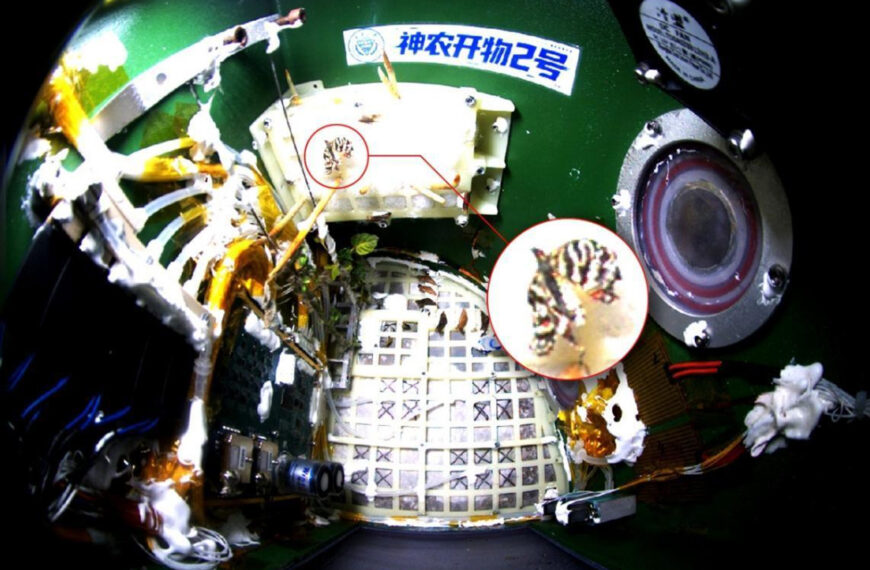
In past months, the crew aboard the Tiangong have treated themselves to succulent BBQ wings, fresh veggies, and even moon cakes. Their latest consignment isn’t for eating, however: it’s a butterfly, which hatched from a chrysalis in zero gravity.
According to the English-language publication People’s Daily, the chrysalis was brought aboard via a Kuaizhou 11Y8 cargo spacecraft back in December. The butterfly pupa was encased in a self-sustaining capsule heated to 86 degrees Fahrenheit, which contained plants and microorganisms to provide a stable environment.
After it emerged from its cocoon, the 14.2-liter chamber sustained the butterfly for “several days.” Though the researchers who prepared the experiment on the ground weren’t sure how the insect would adapt to a zero-gravity environment, it fared surprisingly well. As the researchers explained to People’s Daily, the butterfly had no problem navigating the chamber freely, fluttering its wings and resting on leaves, just as it would on Earth.
“Many people thought the butterfly wouldn’t be able to fly in microgravity, but what we observed was that it quickly adapted to the new environment,” said Xie Gengxin, director of Chongqing University’s Space Science and Technology Research Institute and chief designer of the experiment.
Though it’s not the first butterfly to undergo metamorphosis in space — that honor belongs to a monarch aboard the ISS in 2009 — it could probably win the superlative “most stressed.”
According to Xie, the experiment was designed to maximize the chrysalis’ exposure to the harsh reality of space; unlike previous attempts, this butterfly pod had no radiation shielding, temperature control, or full-spectrum lighting, let alone interference from humans.
“The transformation process was entirely unmanned, unlike previous experiments (of other countries) aboard the International Space Station,” Xie said.
If Xie sounds a little proud, he’s certainly earned the right to be. He was also the lead designer behind the first-ever plants to grow leaves on the Moon, as part of the Chang’e 4 robotic mission. In the future, he imagines both experiments could be used to inform the construction of space farms, where butterflies act as pollinators.
“True ‘space farming’ aims to utilize space resources for agricultural production,” Xie said. “Lunar and Martian farms will become a reality in the future.”
More on China: China Planning Crackdown on AI That Harms Mental Health of Users
The post Butterfly Emerges From Chrysalis in Zero Gravity appeared first on Futurism.