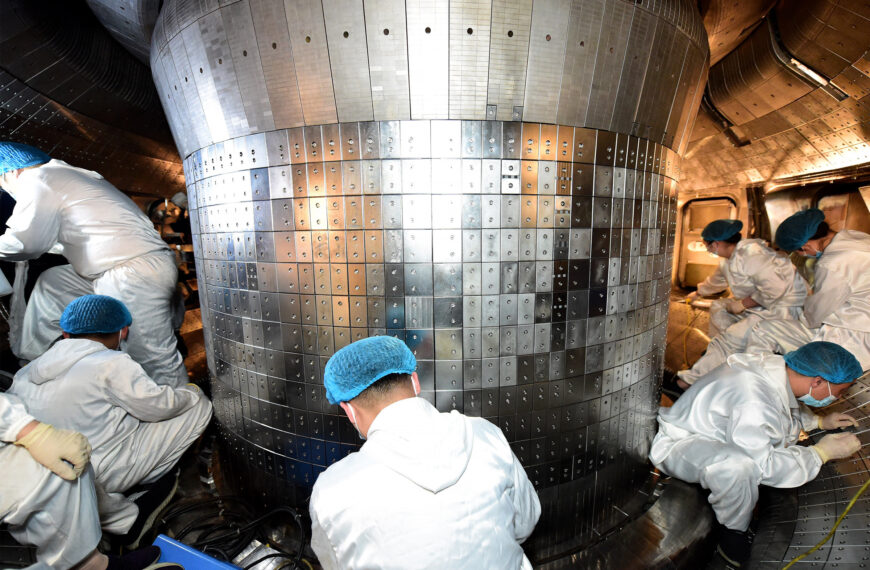
Scientists at China’s Experimental Advanced Superconducting Tokamak (EAST) program rang in the new year with a stunning accomplishment: empirical evidence that they used the device to achieve nuclear plasma densities once thought to be beyond human capabilities.
On January 1, researchers at the Hefei Institutes of Physical Science at the Chinese Academy of Sciences published a wild new study in the journal Science Advances. In it, the team details the way they used EAST — which has memorably been dubbed China’s “artificial sun” — to achieve a plasma density far higher than previous limits.
Nuclear fusion is the process by which two atomic nuclei combine to form a single, heavier nucleus, resulting in a huge release of energy. Because of its potential to produce limitless clean energy, scientists the world over have sought ways to use nuclear fusion as a viable power source.
One difficulty, however, is that all atomic nuclei have a positive charge, meaning they’re naturally repulsed by each other — think two magnets with opposite poles. To give atomic nuclei enough kinetic energy to combine into one, scientists must heat the fuel into a super-dense plasma at about 150 million kelvin, or 27 million degrees Fahrenheit, the researchers explained in a press release.
But to reach a point where this brew can power itself — a sustainable fusion reaction — requires that gnarly plasma to stay hot, dense, and stable for long stretches of time. For years, it was understood that higher plasma densities would inevitably result in instability, collapsing the fuel before it could ignite, a threshold known as the Greenwald limit.
This new research seemingly flips all that on its head. As the EAST team explains, the method basically involves creating a high gas pressure environment in the reactor prior to plasma formation, which allows the plasma to interact with the reactor wall in a much less destructive way than it would otherwise. Scientists also manually pump extra energy into the plasma as it heats, allowing an even rise in density.
The result is a plasma that remains stable even as its internal density rises, resulting in fuel densities “far exceeding empirical limits.”
“The findings suggest a practical and scalable pathway for extending density limits in tokamaks and next generation burning plasma fusion devices,” said Ping Zhu, one of the study’s co-authors and a plasma physicist at the Huazhong University of Science and Technology.
While there are still plenty of breakthroughs left before humanity achieves practical power production with fusion, shattering the Greenwald represents a major item on the to-do list — and another notch on China’s lengthy green energy belt.
More on energy: Google Rapidly Deploying Huge CO2 Battery Facilities That Store 200 Megawatt Hours of Power
The post Chinese Fusion Reactor Achieves Plasma Density Previously Thought to Be Impossible appeared first on Futurism.