
Last night, congresswoman Haley Stevens published a blog post on X-formerly-Twitter titled “The Decisions We Make.” In the nearly-900-word post, the Michigan Democrat explained her controversial decision to endorse Republican Mike Rogers for Michigan’s open Senate seat — rescinding her endorsement of the Democratic candidate Abdul El-Sayed, who had beaten Stevens in the Democratic primary several months earlier.
The Michigan race is among the most contentious midterm elections in the country and could play a pivotal role in tonight’s fight for control of the Senate. Stevens’ withdrawal of her support for El-Sayed in the race has prompted intense backlash from other Democrats who have accused her of betrayal, while many Republicans — including president Donald Trump — have praised her for crossing party lines.
Stevens went on CNN in an attempt to explain the switch, but the interview backfired badly in what one commentator called “one of the most bizarre and incoherent political interviews I can recall.”
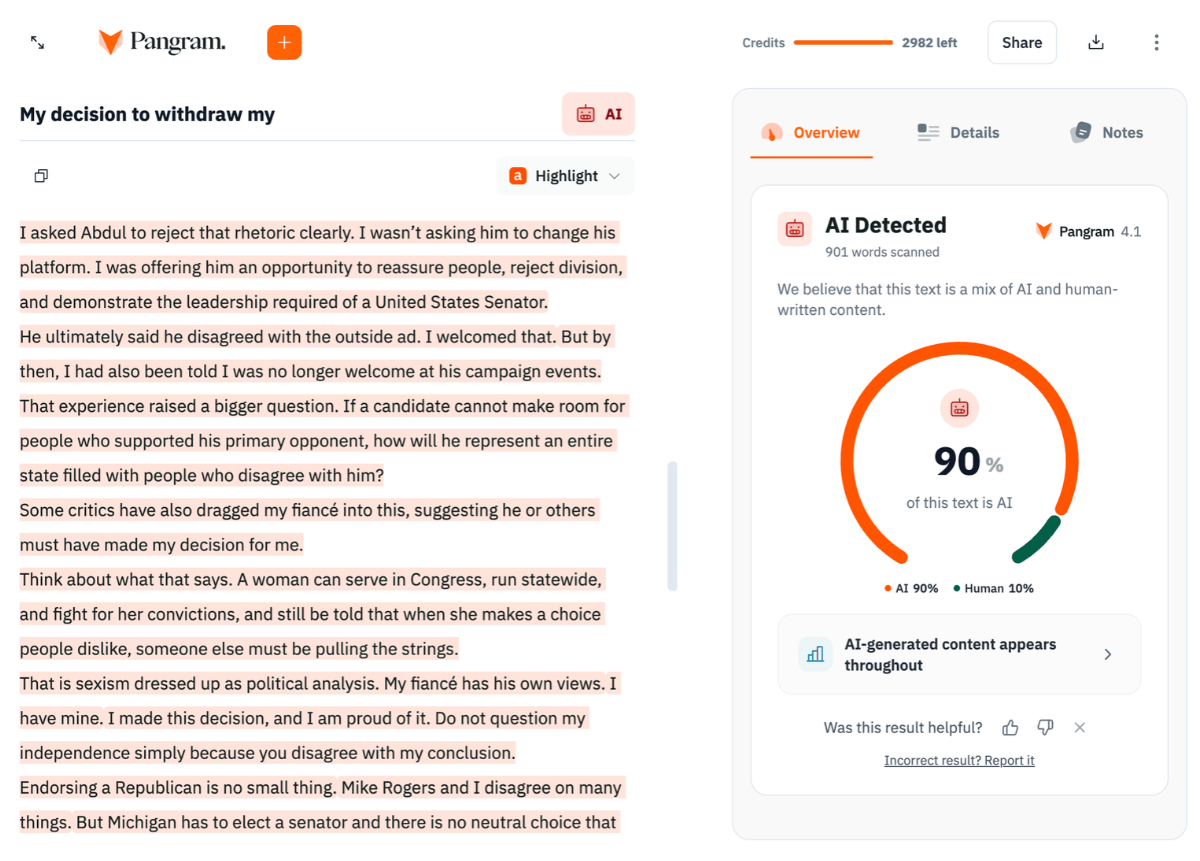
Stevens’ blog post isn’t landing the way she wanted, either. In it, the Michigan lawmaker attempts to set the record straight on a choice that, as she puts it, “has angered many Democrats.” But it’s not clear that Stevens even wrote it herself: according to the AI detector Pangram — which isn’t perfect, though independent testing has found it to be accurate in the vast majority of cases — the missive is mostly AI-generated.
The piece includes notorious AI-isms. The lengthy memo utilizes a variation on “it’s not X, it’s Y” framing, a now-classic hallmark of AI-generated content, with Stevens’ piece describing something as “X dressed up as Y.” It also leans heavily on the “rule of three,” a writing technique that chatbots frequently employ.
“Some critics have also dragged my fiancé into this, suggesting he or others must have made my decision for me. Think about what that says. A woman can serve in Congress, run statewide, and fight for her convictions, and still be told that when she makes a choice people dislike, someone else must be pulling the strings,” reads the missive. “That is sexism dressed up as political analysis.”
We ran the “The Decisions We Make” through the AI detector, which concluded that the text was likely 90 percent AI-generated. Others who shared Pangram analyses online drew similar results.
We reached out to Stevens, but didn’t immediately hear back.
AI use by politicians has drawn scrutiny as chatbots appear to be more and more popular among lawmakers. Earlier this year, the Washington Post reported that an astonishing amount of legislation is now being written with AI, with little oversight. Lawmakers in the US and abroad have also been caught leaving AI text on their websites and even in speeches.
More on AI-generated content in politics: The Logo for Donald Trump International Airport Appears to Be AI Slop
The post Did Haley Stevens Use AI to Write Her Blog Post About Her Controversial Endorsement? appeared first on Futurism.