
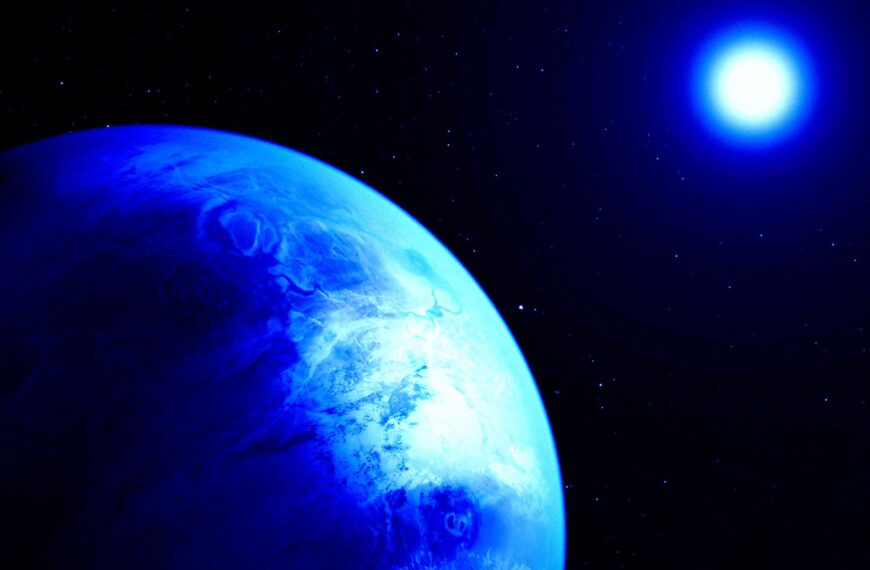
Did the Earth once have a larger cousin that was devoured by the Sun? And more importantly: would we have any way of knowing it did?
A team of astronomers believe that the answer to both of those questions is “yes.”
Like investigators at a crime scene, a team of researchers say they’ve discovered a method to dust for “fingerprints” in the Sun to find strong evidence of planetary filicide in its past.
Their resulting study, published in the Monthly Notices of the Royal Astronomical Society, suggests that the devoured rocky world — which is believed to have been a so-called super-Earth several times more massive than our own — may have left a “lasting chemical imprint deep inside” our star, according to coauthor Mutlu Yildiz.
“By modeling the sun’s evolution and comparing the results with precise observations of its interior,” Yildiz, a professor at Ege University in Turkey, said in a statement about the work, “we find that the ingestion of a super-Earth could help explain long-standing differences between standard solar models and observations, including subtle changes in the Sun’s internal structure and its depleted lithium abundance.”
These discrepancies are likely connected, according to the researchers.
Explained Yildiz, “young stars are surrounded by protoplanetary disks, where substantial amounts of material can move between the disk and the star.”
“Since planets are made of material that is chemically different from the gas in the disk,” he added, “we wondered whether the early engulfment of a planet could have left a chemical signature inside the young Sun.”
To explore this, the researchers used an open-source stellar evolution software called Modules for Experiments in Stellar Astrophysics, or MESA for short, to create different solar models based on how the Sun’s accretion history — how it gathered matter over time and what materials it ingested — and compared them with present-day acoustic measurements of the Sun’s internal structures.
Their work supported the idea that a nascent Sun swallowed a super-Earth between five to ten times the mass of our planet, which they say could explain the Sun’s low lithium levels. If true, the dissolved planetary material is hidden somewhere below the Sun’s convection zone, a turbulent layer that sits between the star’s core and its outer atmosphere.
This scenario could also explain another mystery: why super-Earths are commonly found in other star systems, while ours have none. While the paper falls short of finding the smoking gun, it tells us where to look.
“The next step is to see if these fingerprints can be independently detected,” Yildiz said.
More on space: Scientists Baffled by Bizarre “Anomaly” Deep Beneath the Surface of Mars
The post Earth May Have Had a Larger Cousin that the Sun Devoured appeared first on Futurism.