After their grisly destruction in a terror attack in 2001 — and the chaotic and deadly wars that followed — it can be hard to remember that the World Trade Center’s Twin Towers, originally completed in 1973, were architecturally controversial for their impact on the Manhattan skyline.
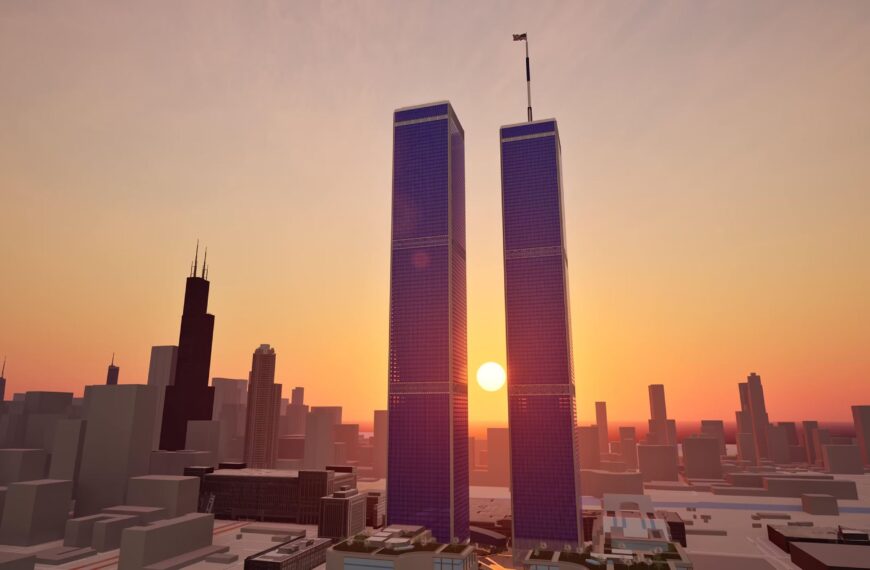
Now, a long-shot effort seeks to rebuild them in an unlikely locale: Chicago, where they’d be reborn as massive data centers.
Behind the campaign is Raphael Chryslar, who might seem like an unlikely candidate for the project. Currently residing in Hatfield, England, he was just a toddler when the original Twin Towers fell. Trained in aerospace engineering — and a self-described author, photographer, entrepreneur, and aspiring architect and astronaut — Chryslar is clearly a superfan of the originals: he’s even gone so far as to get a tribute to the original World Trade Center tattooed on his arm.
Called the World Tech Center, Chryslar’s project envisions nine buildings across a 35-acre campus in the Windy City’s downtown. The new Twin Towers, reconceptualized for the 21st century, would get plenty of upgrades to make them “substantially safer than their predecessors.” These include a meter-thick central core crafted from ultra-high-performance concrete, fireproof steel I-beams, tuned mass dampers each full of 1,000-tonnes of water, foam fire-suppression systems, pressurized stairwells, a dedicatedfire department, and a firefighting drone launch pad.
Perhaps the most sci-fi improvement would be an “aerial threat detection and neutralization system,” which Chryslar’s website describes as having a radar system, radio and communications sensors, and a “last resort anti-aircraft surface-to-air missiles or a multi-megawatt laser defense weapon.”
That arsenal would have plenty to defend. Far from workaday office buildings, Chryslar would see the towers reimagined as sprawling STEM laboratories. The north tower, focusing on technology, would house all manner of computing laboratories, data centers, and lecture rooms, attracting anyone from software engineers to video game developers. The south tower, meanwhile, would host the science compliment, complete with more labs, university offices, and research and development cleanrooms.
In addition, the fully realized infrastructure project would also include a physics and engineering mega facility; a chemistry and biological sciences lab with penthouse suites; a performing arts center; a massive atrium; a 10-story NASA workshop; a major 4-star hotel; and last but not least, a sprawling subterranean shopping mall inspired by the film “2001: A Space Odyssey.”
“Our vision reincarnates that American symbol of peace and strength that was wrongfully taken from us nearly 25 years ago, and with it thousands of innocent lives,” Chryslar’s WTC website proudly declares. “Their familes [sic] and the wider community cry out to restore and heal. This is what America rightfully deserves. We shall no longer be afraid.”
How far the landmark plan gets remains to be seen. Chrsylar lays out a long-reaching eight-part strategy, which targets an opening in the year 2050. In an email, Chryslar told Futurism that the project is currently in “phase 2,” gathering community feedback and building a coalition ahead of formal organization. More details are promised in the months ahead; for now, Chryslar’s just getting warmed up.
More on engineering: A Machine Learning Engineer Thought He Was Safe From AI Layoffs. Then He Got Some Depressing News
The post Engineer Says It’s Time to Rebuild the Twin Towers as Giant Data Centers With Anti-Aircraft Lasers on the Roof appeared first on Futurism.