
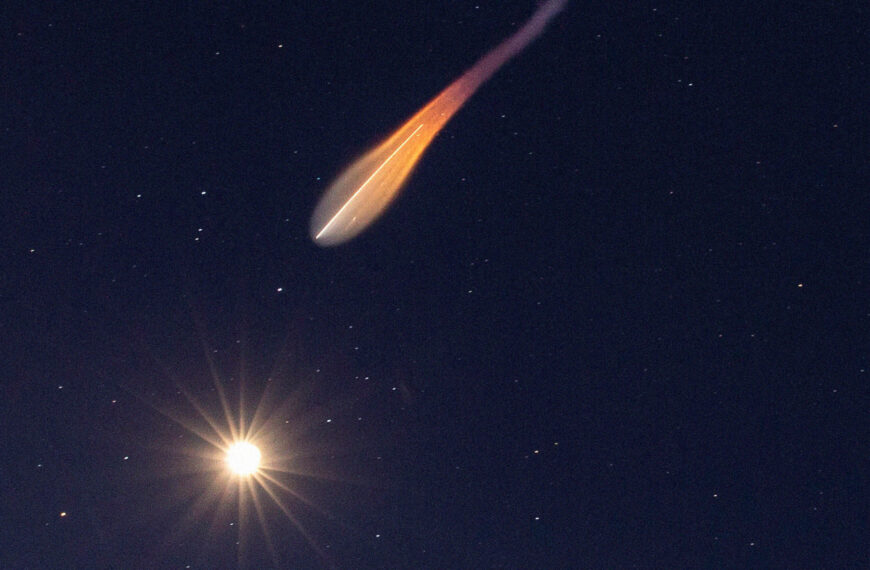
Just over a year ago, the upper stage of a SpaceX Falcon 9 rocket plummeted back to the ground after delivering 23 Starlink satellites to low-Earth orbit.
It was a routine mission, one out of hundreds of rocket launches that have delivered just shy of 10,000 broadband-beaming satellites total into space — and it belched a massive cloud of lithium and other pollutants roughly 62 miles over Europe upon its uncontrolled return, as scientists detailed in a new paper published in the journal Communications Earth & Environment.
Researchers have grown concerned about the environmental impact on our planet’s upper atmosphere as satellite launches become increasingly common. It’s not just SpaceX; several other companies and governments are planning to launch their own satellite constellations. Worse yet, the satellites have a limited shelf life, which means we’ll be required to keep launching their replacements ad infinitum — in traffic that appears to be unintentionally pumping the atmosphere full of chemicals.
Rocket launches seem to be injecting metals and other pollutants into the atmosphere as they enter space and make their return. Using a resonance lidar in Germany, for instance, the international team of researchers observed a massive lithium plume from the uncontrolled reentry of the previously mentioned SpaceX rocket in February 2025 at an altitude of 62 miles west of Ireland.
SpaceX’s rocket bodies are made of a special aluminum-lithium, an aerospace-grade alloy that reduces weight. Reentry heats up this material, causing it to break down.
The team claims it’s the “first measurement of upper-atmospheric pollution resulting from space debris re-entry and the first observational evidence that the ablation of space debris can be detected by ground-based lidar.”
It’s important to note that there’s a lot we still don’t know about the long-term effects of these pollutants. But given how many rocket parts are expected to reenter the Earth’s atmosphere, it’s certainly worth exploring, they argue.
“This finding supports growing concerns that space traffic may pollute the upper atmosphere in ways not yet fully understood,” the team wrote in its paper. “Continued growth in satellite launches and re-entries may lead to cumulative effects, with implications for long-term atmospheric composition and climate interactions.”
To experts, it’s a particularly concerning finding considering the possible implications for our planet’s ozone layer, a protective layer of gas ten to 25 miles above the surface that absorbs the vast majority of harmful UV radiation from the Sun.
A 2024 study, for instance, found that satellites could equally be injecting harmful pollutants such as aluminum oxides into the upper atmosphere as they burn up during reentry.
But the sheer scale of a Falcon 9 upper stage alone, which measures up to 46 feet in height, has experts concerned. Leibniz Institute of Atmospheric Physics professor Robin Wing, coauthor of the latest paper, put the amount of lithium into context, telling the BBC that small meteors deposit around 50 to 80 grams of the element a day naturally.
“So, a single Falcon 9 rocket has about [66 pounds], so this is quite a lot more,” he said. “Our largest concern is aluminium and aluminium oxides interacting with the ozone layer.”
But for now, the exact implications on the atmosphere’s ability to control the climate and temperature remain unknown.
“This is a new scientific field,” Wing told the BBC. “It’s hard to speculate because it’s changing so quickly. I hope that if we start our measurements now, perhaps we can get ahead of the curve and identify any potential problems before they become serious.”
More on SpaceX pollution: Elon Musk Slammed for Filling Orbit With Space Junk
The post Huge Plume of Pollution Linked to Something That Will Not Make Elon Musk Happy appeared first on Futurism.