
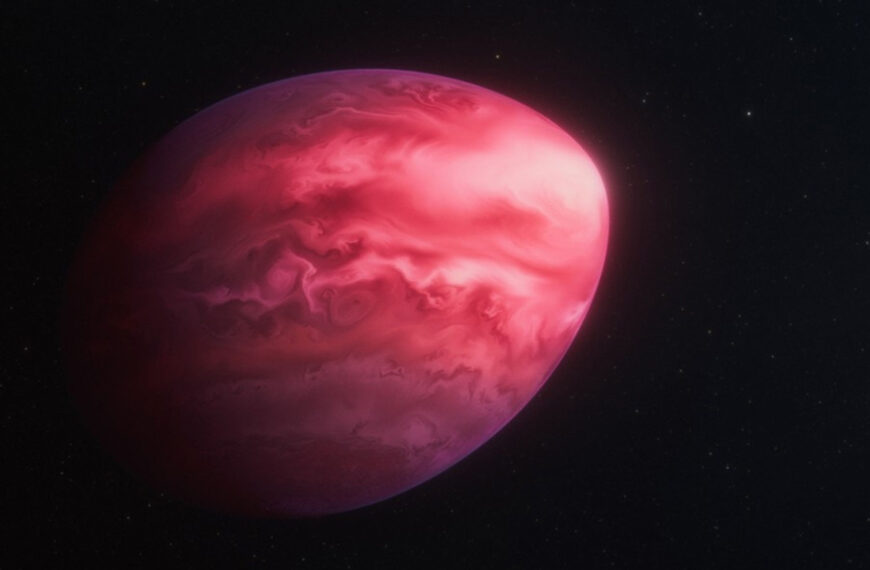
Astronomers using the James Webb Space Telescope have discovered an astonishing exoplanet that’s stretching our understanding of what’s possible for these distant worlds. And when we say say “stretch,” we mean it literally.
The roughly Jupiter-mass object, designated PSR J2322-2650b, orbits just one million miles away from its star, or one percent of the Earth’s distance from the Sun, with a single “year” lasting just 7.8 Earth hours. And at such proximity, the extreme gravity of the star — an exotic type known as a pulsar — pulls the entire planet into an oblong shape, like a lemon or a football.
The findings, published in a new study in The Astrophysical Journal Letters, are so unusual that the astronomers are having to consider if they represent an entirely new class of cosmic object.
“It’s the stretchiest planet that we’ve confirmed the stretchiness of,“ lead author Michael Zhang, an exoplanet scientist at the University of Chicago, told the New York Times.
The planet’s sun is a type of rapidly spinning neutron star. These are the almost impossibly dense stellar cores that are left over in the aftermath of a supernova, containing mass equal to our entire Sun in a package the size of a human city. (The resulting gravity is so extreme that if you could scoop just a tiny teaspoon of one of these objects without being instantly crushed into a soup of pure neutrons, which is what neutron stars are, it’d weigh trillions of pounds.)
Some of these neutron stars spin, becoming pulsars, and emit a sweeping beam of energy along its poles like a lighthouse, appearing to telescopes as a repeating signal.But since it emits mostly in gamma rays, it also means its light is invisible to telescopes like the James Webb, which see in infrared wavelengths. This provides a perfect opportunity to study an exoplanet, which are often outshined by the light of their star.
“This system is unique because we are able to view the planet illuminated by its host star, but not see the host star at all,” coauthor Maya Beleznay, a physicist at Stanford University, said in a NASA statement. “So we get a really pristine spectrum. And we can study this system in more detail than normal exoplanets.”
Their observations revealed that just as unusual as the planet’s lemon shape is the composition of its atmosphere. With surface temperatures up to 3,700 degrees Fahrenheit —which is four times hotter than Venus, the hottest world in the solar system — it’s almost entirely dominated by helium and carbon, something that’s never been seen before on any planet. That’s because molecular carbon easily binds with other elements commonly found on planets and especially gas giants, such as oxygen and nitrogen, suggesting that these elements must not be present.
With a weird composition comes deeply peculiar weather. The astronomers speculate that clouds of carbon soot float through the air. Near the core of the planet, these clouds can condense into shards of solid diamond.
As it stands, everything about PSR J2322-2650b is an enigma. Few pulsars are known to have a planet, let alone one that’s shaped like a lemon, has graphite for clouds, and lacks the elements detected on other worlds.
One possibility is that this configuration is actually a type of star system known as a black widow binary, in which the pulsar slowly siphons material from a smaller stellar object in its orbit, sucking the life out of it until it’s devoured completely.
But this has only been observed between a pulsar and another star, not a planet. That raises the possibility that the exoplanet is actually some kind of stellar remnant that’s already been whittled away at for eons. “It would have lost 99.9 percent of its mass, and we just happened to catch it right at the very end,” coauthor Peter Gao of the Carnegie Earth and Planets Laboratory in Washington told the NYT.
The more exciting alternative is that we’re witnessing an “entirely new type of object that we don’t have a name for,” Zhang suggested to the paper.
“Did this thing form like a normal planet? No, because the composition is entirely different. Did it form by stripping the outside of a star, like ‘normal’ black widow systems are formed? Probably not, because nuclear physics does not make pure carbon,” Zhang elaborated, via NASA. “It’s very hard to imagine how you get this extremely carbon-enriched composition. It seems to rule out every known formation mechanism.”
More on space: Scientists Detect Huge Rotating Structure in Space
The post James Webb Discovers Planet Shaped Like Lemon appeared first on Futurism.