In particle physics, atoms are the building blocks of matter in the universe, each consisting of a nucleus, protons, neutrons, and electrons.
Scientists have increasingly peered even further into these building blocks, examining the peculiar world of particles that are even smaller than individual atoms. According to the quark model, multiple subatomic particles called quarks can form hadrons held together by strong nuclear forces. Each of these quarks can come in three pairs of “flavors” — up and down, charm and strange, and top and bottom — that determine their mass and charge.
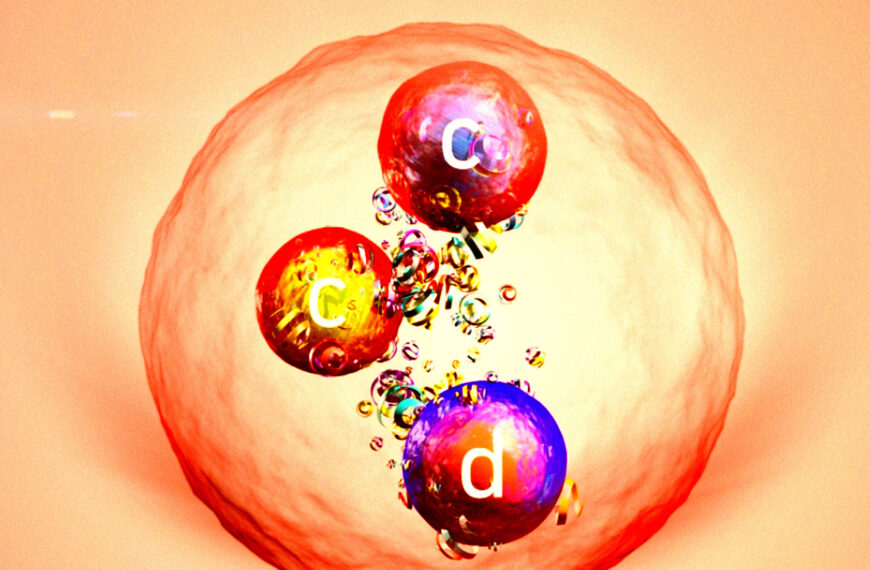
Now, scientists have used CERN’s Large Hadron Collider (LHC) near Geneva, Switzerland, to uncover what they say is an entirely new type of particle, dubbed Xi-cc-plus, that consists of two charm quarks and one down quark. That makes it not unlike a proton, albeit with two heavy charm quarks replacing its two up quarks.
Put simply, the LHC uses copious amounts of energy to fire hadrons together inside an enormous machine. The goal is to produce exotic subatomic particles that tend to be extremely unstable and short-lived, including baryons and mesons, both of which are types of hadrons.
So far, scientists have used the LHC to discover 80 new hadrons, including the latest one.
“This is the first new particle identified after the upgrades to the LHCb detector that were completed in 2023, and only the second time a baryon with two heavy quarks has been observed, the first having being observed by LHCb almost ten years ago,” said LHCb spokesperson Vincenzo Vagnoni in an announcement of the findings.
The LHCb — or Large Hadron Collider beauty — experiment is a detector collecting data at the LHC, which specializes in the detection of heavy particles that contain bottom and charm quarks.
“The result will help theorists test models of quantum chromodynamics, the theory of the strong force that binds quarks into not only conventional baryons and mesons but also more exotic hadrons such as tetraquarks and pentaquarks,” Vagnoni added.
The new particle is four times as heavy as a regular proton. The forces holding it together grow as the distance increases, not unlike a rubber band, as The Guardian explains.
“The more we learn about these particles, the more we can learn about the strong force, and that is the same strong force that binds our protons and neutrons together,” University of Manchester physicist Chris Parkes told the newspaper.
The latest discovery was exceedingly challenging to pull off. Despite closely resembling a different particle that was discovered by the LHCb in 2017 — the new particle features an up quark while the older one has a down quark instead — its lifetime is up to six times shorter.
“This is just the first of many expected insights that can be gained with the new LHCb detector,” University of Warwick professor Tim Gershon, who will take over the lead at the LHCb in July, told The Guardian.
More on subatomic physics: Bizarre Subatomic “Quasiparticle” Reproduces Like a Living Cell
The post Large Hadron Collider Discovers All-New Particle appeared first on Futurism.