The tech behind 3D printing has come an extremely long way. The additive manufacturing technique, which generally involves depositing one layer at a time, has gone from relatively crude rapid prototyping in industrial settings to high-end fabrication of detailed parts in a growing list of fields, from medical implants to the construction of entire neighborhoods and rocket engines.
Now, MIT researchers have devised new tech that can 3D print entire complex machines with moving parts in a matter of hours. As Gizmodo half-jokingly points out, it brings us one small step closer to being able to “steal a car” by downloading it from the internet, as suggested in the slogan of the much-derided anti-piracy ad from the early 2000s.
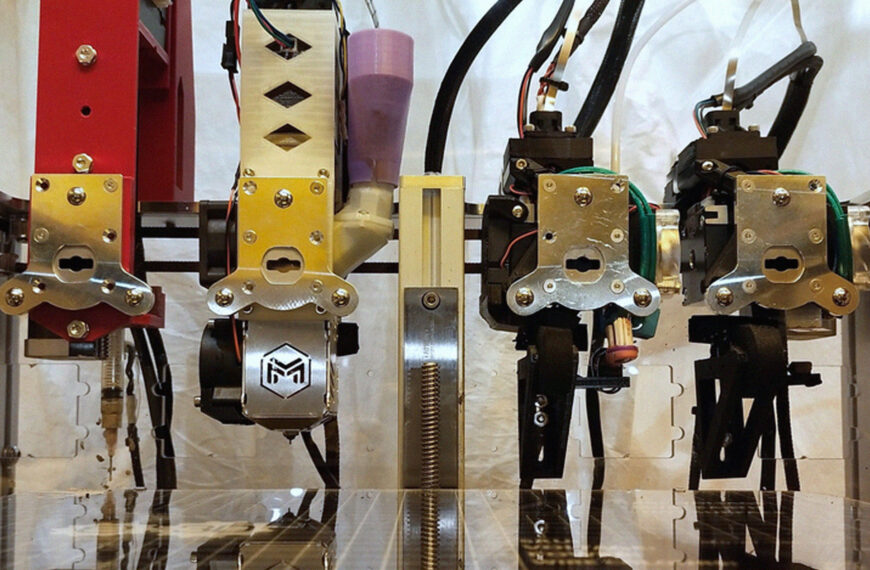
The team came up with a retrofitted 3D printer, which features four separate extruders that can deposit a wide variety of printable materials, including magnetic and conductive ones, by squeezing them through a nozzle.
The novel 3D printing platform was capable of printing an electric linear motor, a simple type of electric motor that is widely used in CNC machining and other industrial robots, by using just five different materials in only three hours.
The total cost of materials: just 50 cents.
As detailed in a new paper published in the journal Virtual and Physical Prototyping, the MIT team used the device to print solenoids, which are electromechanical devices that convert electrical energy into linear motion, as well as hard magnets and springs, then assembled them into what they claim to be the “first fully 3D-printed electric motor.”
“This study demonstrates the capability of multi-modal, multi-material extrusion 3D printing to fabricate all critical components of electrical machines, with magnetization of the hard magnets being the only post-printing step,” they concluded in their paper.
Best of all, after steadily improving their 3D printing platform, they found that the resulting motor was even more powerful than ones that weren’t 3D printed, and could generate “several times more actuation than a common type of linear engine that relies on complex hydraulic amplifiers,” according to an official statement.
“Even though we are excited by this engine and its performance, we are equally inspired because this is just an example of so many other things to come that could dramatically change how electronics are manufactured,” said senior author and MIT Microsystems Technology Laboratories principal investigator Luis Fernando Velásquez-García in the statement.
The team is now envisioning bringing what they’ve learned to the real world, effectively allowing manufacturers to quickly print their own hardware instead of having to order parts, a costly and often significantly slower process.
“This is a great feat, but it is just the beginning,” Velásquez-García said. “We have an opportunity to fundamentally change the way things are made by making hardware onsite in one step, rather than relying on a global supply chain.”
“With this demonstration, we’ve shown that this is feasible,” he added.
More on 3D printing: The Economics of 3D Printed Homes Are Surprisingly Horrible
The post MIT’s New 3D Printer Can Print a Working Motor, Complete With Moving Parts appeared first on Futurism.