Last month, NASA announced that it was launching an unprecedented and risky mission to rescue its aging Swift observatory.
The telescope, which has spent over two decades in orbit studying the most powerful explosions in the universe, has seen its orbit decay over time. With the help of a specialized space tug developed by contractor Katalyst Space Technologies, the space agency was hoping to give Swift a much-needed push to a more stable orbit, prolonging its life.
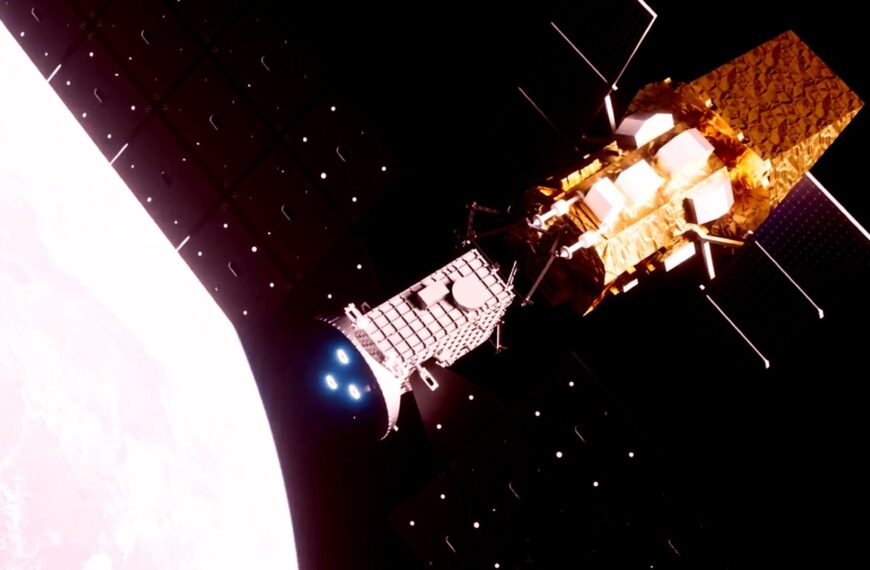
But as it turns out, it’s not the observatory that ended up needing help. After launching its robotic spacecraft, dubbed LINK, on July 3, Katalyst Space watched in horror as it started tumbling out of control following a series of unfortunate events.
According to a new update, NASA admitted that the “spacecraft experienced issues with attitude control, causing the spacecraft to spin and resulting in sporadic communications.”
“Preliminary investigation shows that two of LINK’s three reaction wheels currently are not operable, and there is some loss of functionality in its cold gas thruster system,” the agency noted. Reaction wheels are motor-driven flywheels used by spacecraft for attitude control.
At least there’s a silver lining. LINK’s other subsystems are still functional, allowing the ground team to communicate with the spacecraft.
And not all is lost just yet. The Katalyst team is hoping to stop LINK from spinning before reevaluating how to go forward with the rescue mission, if at all.
But considering that a rapidly spinning spacecraft is the very last thing the Swift observatory needs in its vicinity, it’s clearly not the result the agency was hoping for.
And time is rapidly running out. Without a boost, the telescope is destined to burn up in the Earth’s atmosphere in the upcoming months.
While it has long outlived its originally intended lifetime at almost 22 years old, it’s currently the only orbital telescope that can detect gamma ray bursts, the most powerful explosions in the universe.
Fortunately, the space agency didn’t have to dig too deep into its own pockets. Its Katalyst contract was $30 million, which in the grand scheme of things is a drop in the bucket when considering the untold billions NASA is spending to return astronauts to the Moon.
Even before LINK launched and started spinning out of control, agency officials were content with NASA’s willingness to give it a shot.
“From a programmatics standpoint, I consider this a success already, just from the fact that we’re even going to try this,” NASA astrophysics director Shawn Domagal-Goldman told Ars Technica last month.
More on the mission: NASA Prepping to Launch Extremely Risky Rescue Mission
The post NASA Rescue Mission Spirals Into Crisis appeared first on Futurism.