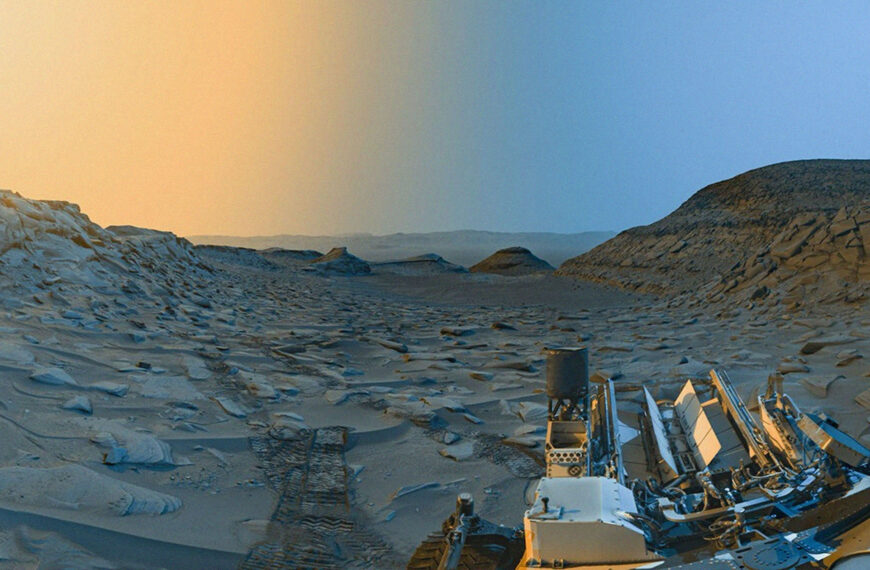
Last year, NASA’s Curiosity rover made a fascinating discovery after boring into a suspected ancient lake bed on Mars: long-chain organic molecules, called alkanes, that could serve as a potential chemical relic of ancient life on the Red Planet.
The molecules, researchers suggested at the time, could have derived from fatty acids, which are common building blocks of cell membranes on Earth, once again strengthening the case that Mars could’ve been teeming with life billions of years ago.
It was just another tantalizing clue in our search for extraterrestrial life, not the smoking gun we’ve all been waiting for.
Nonetheless, scientists continue to be fascinated by the finding. In a paper published in the journal Astrobiology last week, a team led by NASA Goddard Space Flight Center’s Alexander Pavlov argues that the presence of these molecules — despite the millions of years of destructive radiation that pummeled the Martian surface after it lost much of its atmosphere — “cannot be readily explained” by non-biological processes alone.
One theory is that carbon-rich dust particles and meteorites could have deposited these long-chain organic molecules on the surface, with the ancient Martian atmosphere allowing the organics to accumulate billions of years ago.
However, Pavlov and his colleagues aren’t convinced. After studying how 80 million years’ worth of pelting radiation could have affected these molecules, they concluded that prior to the loss of the planet’s atmosphere, the concentration of these alkanes was likely much higher than previously thought. To help explain their findings, they took into account other non-biological processes in an attempt to arrive at their inferred original abundance — but couldn’t, even after combining all of them.
In other words, biological processes like the ones observed on Earth are still a leading theory, even after researchers’ best efforts to find a non-life explanation.
“We argue that such high concentrations of long-chain alkanes are inconsistent with a few known abiotic sources of organic molecules on ancient Mars,” they wrote.
Nonetheless, they stopped well short of making any definitive statements about life on the Red Planet. After all, there could be still-unknown, non-biological processes we don’t know about that could have resulted in the observed concentration of long-chain carbon molecules on Mars.
“We agree with Carl Sagan’s claim that extraordinary claims require extraordinary evidence and understand that any purported detection of life on Mars will necessarily be met with intense scrutiny,” they concluded in their paper. “In addition, in practice with established norms in the field of astrobiology, we note that the certainty of a life detection beyond Earth will require multiple lines of evidence.”
Nonetheless, it’s a tantalizing waypoint in our longstanding efforts to determine whether Mars, a planet that was once covered in huge oceans, rivers, and lakes, could have supported life.
Pavlov and his colleagues are now calling for further research into how radiation degraded these intriguing molecules under Mars-like conditions to shed more light on the matter.
More on Mars: Scientists Find Evidence of Ancient Tropical Oasis on Mars
The post NASA Running Out of Non-Life Explanations for What Its Rover Found on Mars appeared first on Futurism.