
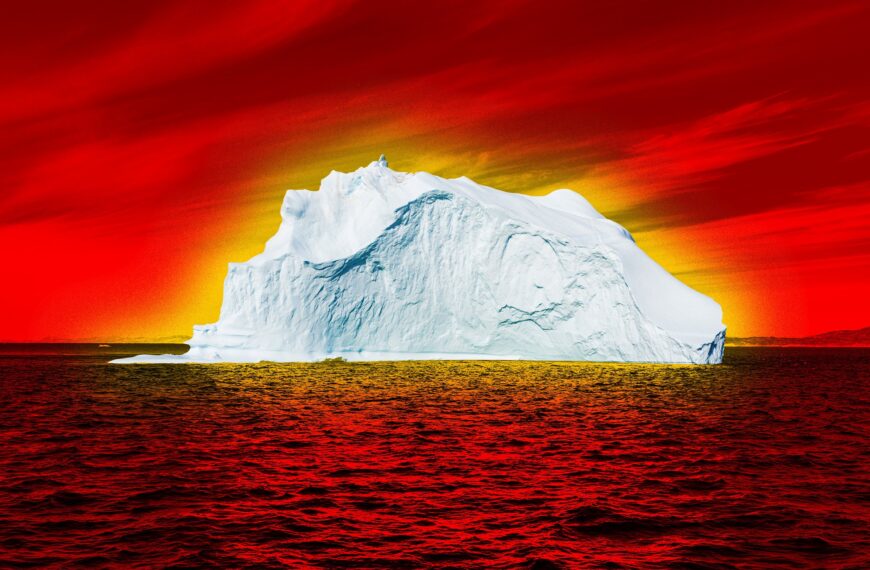
One consequence of climate change you probably haven’t considered? Iceberg traffic.
In a new study published in the journal Nature, researchers from the Technical University of Denmark found that Greenland’s melting glaciers are unleashing a swarm of icebergs into the wider ocean, gumming up shipping routes and unexpectedly transforming marine ecosystems.
“We know from measurements and satellite observations that the large glaciers in Northeast Greenland have lost stability over recent decades,” study coauthor Shfaqat Abbas Khan, a professor at DTU Space, said in a statement about the work. “The new study shows that the consequences do not stop at rising sea levels, but directly affect deep-sea ecosystems far from the glaciers.”
To document the iceberg swarm, the researchers combined four decades of shipboard records with satellite data, sea-ice models, and seabed studies centered on the Fram Strait, a sea passage between Greenland and Svalbard that’s the main gateway between the Arctic and the rest of the world’s oceans.
What they found was something unfolding at a decidedly un-glacial pace: since 2000, the number of icebergs being released from the strait has quadrupled.
The mechanism behind this is twofold: melting glaciers in Northeast Greenland are destabilizing and “calving,” or releasing ice, while sea ice — the ice that forms on the surface of the water — has simultaneously melted, clearing the path for the newly-calved icebergs to throng into the ocean.
Anyone who’s seen “Titanic” will know that having more icebergs around is dangerous for sea vessels. But they’re having an impact on marine life, too. That’s because they contain loads of sediments inside; when the icebergs melt far afield from their homes, they dump rocks onto the formerly pristine seafloor.
Underwater images taken at around 8,000 feet below the surface showed that the “dropstones” are spawning tiny ecosystems — as if all that iceberg traffic were commuters fleeing to a new bedroom town.
“Where previously there were only isolated stones of various sizes, we are now finding much larger accumulations, frequently in small groups. And with each new stone, a permanent settlement is created on the seabed,” coauthor Kirstin Meyer-Kaiser at the Woods Hole Oceanographic Institution said in a statement about the work.
“Sponges, anemones, and other animals that favour hard substrates can settle there,” she added. “As a result, biodiversity in the deep sea is increasing.”
The work reminds us that land processes can be deeply linked with deep sea ecosystems, and how fear reaching — and unexpected — the impact of rising global temperatures can be.
“The Arctic is responding faster to global warming than most other places on Earth,” Khan said in the statement. “Therefore, it is crucial to understand the interaction between ice sheets, the ocean, and ecosystems. This knowledge is necessary if we are to predict and manage the consequences of future climate change.”
More on climate change: Scientists Horrified as Huge Heatwave Hits Antarctica
The post Out-of-Control Icebergs Are Wreaking Havoc on the Oceans appeared first on Futurism.