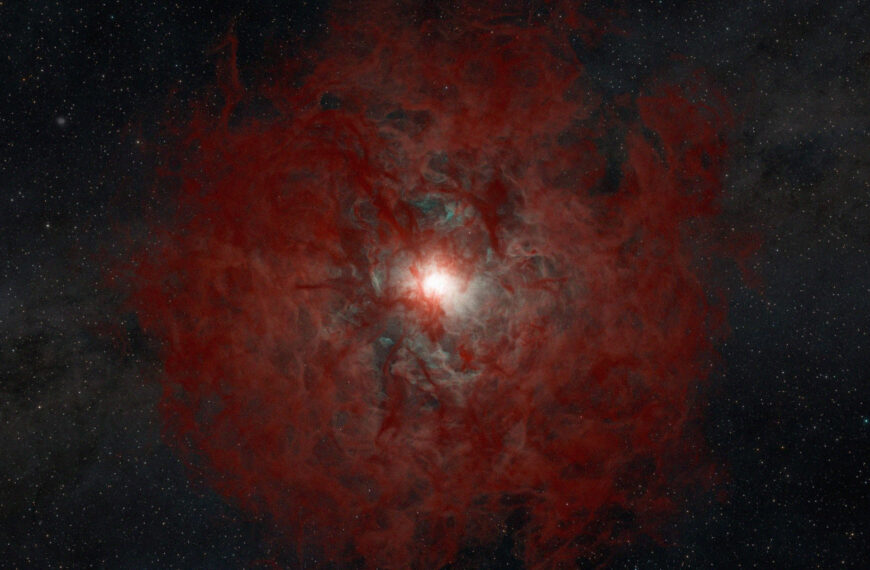
The end of a star’s life can be an extremely violent event. Once it runs out of fuel, its core collapses, and if its original mass is large enough, it can erupt in a supernova, a runaway nuclear fusion event that can release as much energy as the Sun will produce over its entire lifespan of roughly ten billion years. The remains are either a neutron star, an immensely dense lump of matter, or a black hole.
Now, scientists believe they may have observed a star dying in real time. They watched as the star, once one of the brightest in the Andromeda galaxy, quietly winked out of existence.
Columbia University astronomer Kishalay De and his colleagues analyzed 15 years’ worth of data collected by NASA’s NEOWISE spacecraft as part of an effort to measure changes in the amount of infrared radiation millions of stars emit over the years.
One star, dubbed M31-2014-DS1, stood out like a sore thumb — brightening in 2015, fading roughly a year later, and eventually disappearing from view, even in optical light.
“This star used to be one of the most luminous stars in the Andromeda galaxy, and now it was nowhere to be seen,” said De in a statement. “Imagine if the star Betelgeuse suddenly disappeared. Everybody would lose their minds!”
In a research article published in the journal Science, the team suggested that the dimming of the star was the result of a failed supernova.
“In a dying massive star, the core collapses to form a compact object,” the article reads. “Simultaneously, the outer layers can be ejected at high speed, which is observed as a supernova.”
“Theory predicts that sometimes the ejection speed is too low to escape the gravitational field, so the outer layers fall back over several years, producing no supernova and a more massive compact object,” the researchers wrote.
The star in question may have failed to eject its envelope, resulting in a “stellar-mass black hole” and causing it to “disappear” from plain sight.
The conclusion challenges prevailing theories that stars need to have a certain mass to explode in a supernova and turn into a black hole.
“Observations like these are starting to finally change this long-held paradigm that it’s only the very massive stars that turn into black holes,” De told Space.com. If confirmed, the finding means that “there are many more black holes out there than what we’ve anticipated so far,” De added.
It’s an intriguing observation, particularly because these events are far dimmer and harder to observe than supernovas, some of the most energetic events in the universe, sometimes causing the dying star to outshine even its host galaxy, as De explained to NPR.
There has been one other instance of a star mysteriously disappearing, a “failed supernova candidate” dubbed N6946-BH1 that “underwent an outburst in 2009 and has since disappeared in the optical,” according to a 2021 paper. But given the even longer distances involved, plenty of questions remain.
And not everybody agrees that suddenly dimming stars are a sign of a failed supernova. Other scientists argue that disappearing stars could be caused by two stars merging, with the resulting cloud of gas and dust obscuring them.
To gain more clarity, more research is needed.
“Fundamentally, the only way to clearly answer this either way is that one thing distinguishes the black hole case from any other scenario,” Ohio State University astronomer Christopher Kochanek, who coauthored the 2021 paper, told NPR, “and that is that death is forever.”
“Ultimately, it needs to fade to black,” he added.
More on black holes: Scientists Discover Black Hole Created Less Than One Second After the Big Bang
The post Scientists Intrigued as Prominent Star Suddenly Winks Out of Existence appeared first on Futurism.