In 2016, researchers discovered an enormous supercluster of galaxies in the constellation of Vela that had been hiding in plain sight.
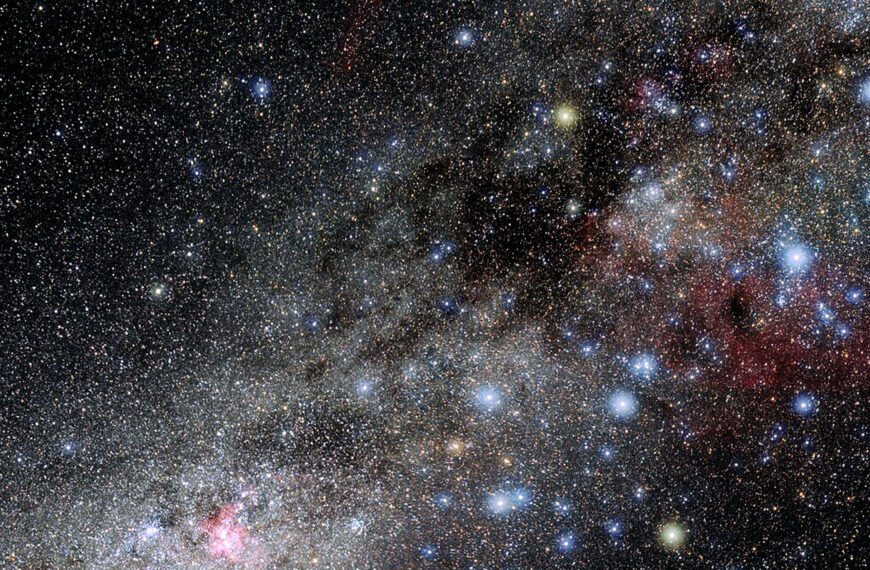
The collection of at least 20 galaxy clusters, each of which is believed to contain hundreds of thousands of galaxies, is located roughly 800 million light-years from Earth within a region called the “Zone of Avoidance.” The region got its name because it’s obscured by our own Milky Way galaxy’s dense dust, gas, and stars — a “dead zone” occupying around 20 percent of the night sky that makes it almost impossible for astronomers to peer beyond it.
Now, ten years after it was first discovered, an international team of researchers says it’s mapped this awe-inspiring Vela Supercluster. As detailed in a yet-to-be-peer-reviewed paper, researchers concluded that the structure is roughly 300 million light-years across, making it around 3,000 times wider than the Milky Way itself, as Live Science explains — far more massive than previously thought.
The findings could allow us to get a better understanding of the largest structures that dominate the universe and how they inform our current models of cosmology, including the age of the universe itself.
The researchers studied the behavior of galaxies at the Vela Supercluster’s edge to determine its size, using observations by two South Africa-based facilities, the Southern African Large Telescope (SALT) and the MeerKAT radio telescope, to detect galaxies deep within the Zone of Avoidance.
The latter can detect the presence of hydrogen gas at radio wavelengths which pass through the Milky Way’s dense cloud of dust, allowing them to uncover previously hidden cosmic structures behind it, according to a statement about the research.
“The millions/billions of stars forming the disk are so dense [and so] close to the galactic plane that we cannot easily see through it,” coauthor and University of Cape Town astronomer Renee Kraan-Korteweg told Live Science. “Moreover, where we have stars, we also have lots of minuscule dust particles, and like the stars, this dust layer gets thicker and thicker as you approach the plane.”
The newly-observed supercluster is a “coherent large-scale structure comparable in size and mass to some of the largest and well-known superclusters in the local universe,” according to Kraan-Korteweg. In terms of mass alone, it contains the equivalent of 30 quadrillion (that’s a million billions) of our Suns, according to the statement.
In terms of size, the Vela Supercluster now neatly fits between other previously mapped superclusters, such as Laniākea, which contains the Milky Way itself, and even larger superclusters, such as Hercules-Corona Borealis Great Wall, the largest known structure in the observable universe.
While it’s a notable advancement in our understanding of what lurks beyond the Milky Way itself, the researchers suggest more powerful radio telescopes could allow us to create even more detailed maps of the Vela Supercluster, allowing us to fine tune our models of the universe even further.
More on the supercluster: Meet Vela, the Huge Supercluster Just Detected by Astronomers
The post Scientists Scan Gigantic Structure Hiding Behind Our Galaxy appeared first on Futurism.