
When you think of saving our oceans, what comes to mind? Maybe you think about reef restoration techniques like coral transplantation, or making small consumption changes like switching from plastic straws. If you have money to dream big, perhaps you might ponder creating a big robot that roams the waters, sucking up floating trash.
Environmental researchers at Texas A&M University are on a whole ‘nother level: they’re proposing massive fire tornadoes.
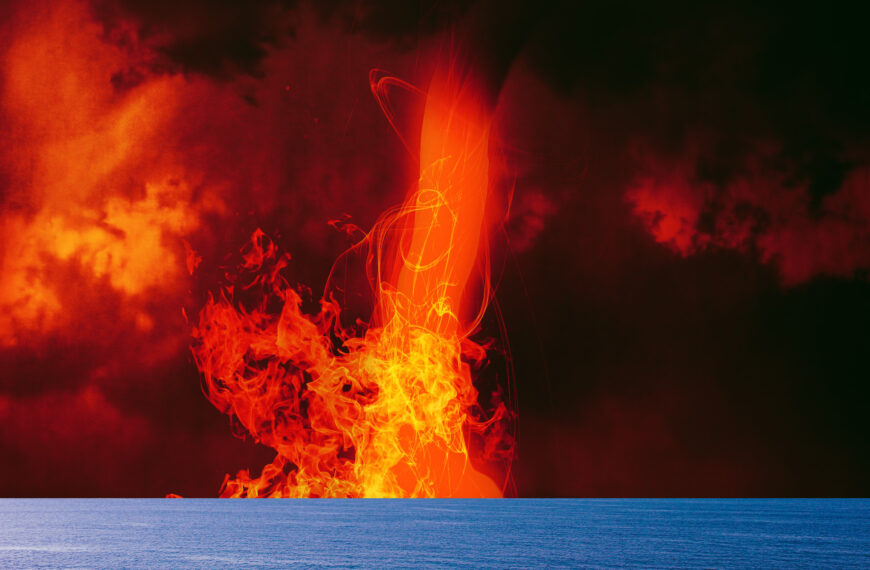
A recent blurb on the university’s website detailed a recent paper in the journal Fuel that aimed to find the most effective way to clean up oil spills. It involves, improbably, lighting massive “fire whirls,” the technical term for the much more evocative phrase the university used: “fire tornado.”
While it sounds counter-intuitive, the experiment explored whether fire whirls could be an effective method to help clean up the thousands of oil spills that occur each year.
The theory is pretty simple: fire whirls, spinning rapidly upward instead of outward, provide a massive boost to oil burn-offs, creating a fire that burns much hotter — and therefore much faster — than typical oil pool burn-offs. (Remarkably, the current world-standard for cleaning an oil spill is to gather a huge pool of crude on the surface and light it, a technique known as in-situ burning.)
To carry out the experiment, researchers built three 16-foot walls, situated in a loose triangle. The result was a controlled fire-tornado reaching 17-feet in height at its largest, which the scientists probed for environmental impact.
Compared to in-situ burn-offs, researchers at Texas A&M found the controlled fire whirl produced 40 percent less soot, while burning off up to 95 percent of the fuel.
“This the first time anyone has conceived using fire whirls for oil spill remediation, and it’s really just the beginning,” said Elaine Oran, professor of aerospace engineering at Texas A&M. “Our goal is to harness the chaotic nature of fire whirls as a powerful, precise restoration tool, to protect coastlines, marine ecosystems and the environment as a whole.”
Going forward, speed is one of the biggest draws inviting further research on fire whirls. “Fire whirls burn through crude oil spills nearly twice as fast as in-situ fire pools,” Oran said, “potentially giving cleanup crews faster operational and response times to eliminating the oils from spreading.”
More on pollution: Site of Elementary School Was Sprayed With Radioactive Fracking Waste, Worker Warns
The post Scientists Suggest That Igniting Oil Spills to Create Fire Tornadoes Might Actually Be Good for the Oceans appeared first on Futurism.