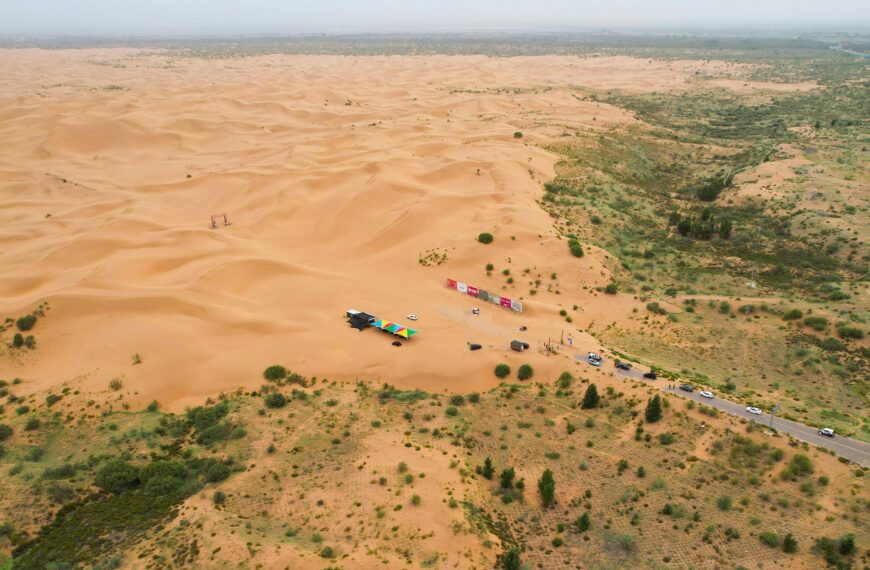
Over the past five decades, China has planted 66 billion trees in a massive wall that spans the Gobi and Taklamakan deserts. This reforestation effort intended to stop the deserts’ spread is working — but, it turns out, with a surprising twist.
In a new study published in the journal Geophysical Research Letters, researchers found that the trees planted in the so-called “Great Green Wall” appear to grow faster than trees in natural forests, possibly because they respond to the rising CO2 levels in our atmosphere better.
Still, it’s mysterious. Study lead author Yuhang Luo, a landscape ecologist at Peking University in Shenzhen, told Live Science that it’s unclear how the artificial forests different from the natural ones, raising questions about their effectiveness at sucking up carbon.
The Great Green Wall project began in 1978 and is expected to be completed by 2050. The original intent was to slow the desertification of the country’s grasslands, of which the Gobi devours over a thousand square miles every year. In its early stages, the initiative struggled to get off the ground, as some of the trees chosen for their quick growth turned out to be poorly suited for the environment and died off.
But Chinese scientists pushed on. In a monumental feat of planning and perseverance, the verdant barrier has continued to grow instead of dying off — a fate that commonly befalls other green wall initiatives that learned that you can’t brute force your way into planting as many trees as possible. Forest cover in the regions the wall touches has ballooned from 5 percent in 1978 to 14 percent in 2023, according to a Nature article, which has helped cut down on dust storms and improve the air quality in downwind cities, including Beijing.
The Great Green Wall, however, wasn’t originally intended as a climate change mitigation measure. So Luo and his colleagues were curious to see how the planted forests hold up in that regard.
“Planted forests are widely used in climate mitigation strategies, but most global ecosystem models do not distinguish between forest types or represent age-related dynamics adequately,” Luo told Live Science. “So we felt it was important to clarify how these factors interact — not just for scientific understanding, but also for improving the models and assumptions that underpin real-world forest policy and carbon accounting.”
To do that, they used satellite data to track the density of the Green Wall’s canopy, a measurement known as a leaf area index, and compared it with natural forests in the country. Strikingly, they found that the leaf area of the planted forests increased 66 percent faster than their natural counterparts.
A lot of this is because young trees grow faster than old ones, Live Science noted. The planted forests are also actively nurtured by humans, instead of being left to grow on their own. But when the scientists compared planted and natural forests of similar ages and conditions, the planted ones still appeared to grow 4.6 percent faster.
Notably, the difference was greatest when planted trees are around 30 to 40 years old, before sharply declining. Natural forests, meanwhile, grow at a slower but steady rate, making them better at sequestering carbon in the long term.
“Planted forests can be a powerful short-term tool for carbon uptake, but this advantage is temporary,” Luo told Live Science. “For long-term carbon storage and resilience, natural forests remain irreplaceable.”
More on the environment: Scientists Rush to Save One of the World’s Rarest Trees as It Literally Falls Off a Cliff
The post Something Weird Is Going on With the 66 Billion Trees China Planted in a Huge Wall appeared first on Futurism.