
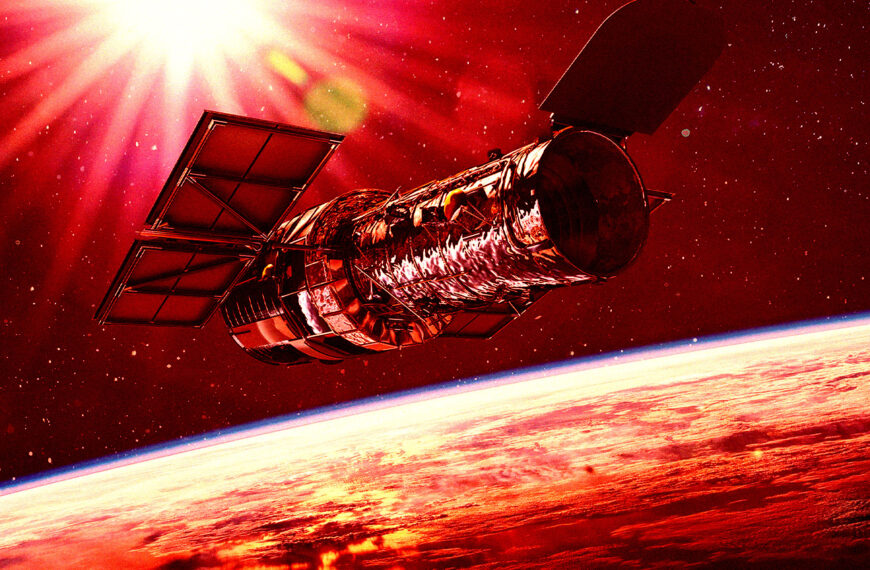
For years now, NASA’s Hubble Space Telescope has had its fair share of brushes with death. The groundbreaking observatory launched into low-Earth orbit 36 years ago, and it’s now been operational two decades longer than its expected lifespan, delivering a treasure chest of invaluable scientific insights that have greatly expanded our understanding of the universe.
But time hasn’t been kind to the telescope. It’s been in and out of “safe mode” several times, had computer glitches bring it to its knees, and even started teetering thanks to most of its six gyros designed to keep it stabilized breaking down.
Most severely of all, its orbit has steadily decayed, foreshadowing its ultimate demise as much of it burns up in the Earth’s atmosphere and any remains plummet to the planet below.
For decades, Hubble has circled our planet in a circular low-Earth orbit at an altitude of approximately 340 miles. But how much longer it will be able to hang on has become increasingly uncertain.
According to a graph posted on Bluesky by Harvard astronomer and space tracker extraordinaire Jonathan McDowell, the historic artifact could deorbit sooner than expected, possibly even before 2030. The visualization shows its altitude plunging from around 330 miles to just 300 miles between 2020 and 2026, a major decline compared to more steady downward shifts since the late 1990s — a “death spiral,” in the reckoning of The Register.
In contrast, per NASA’s website, Hubble is “not expected to re-enter Earth’s atmosphere until the mid 2030s at the earliest,” despite atmospheric drag causing its altitude to “slowly” decrease.
“A propulsion module will eventually be attached to the telescope to complete either a controlled reentry into the South Pacific Ocean, or to boost Hubble into a much higher orbit to keep the inoperative telescope aloft for several more decades,” the space agency’s website reads. (However, when the page was last updated and whether NASA still has plans to visit the telescope once more for such an upgrade, remains unclear.)
What makes it an especially bittersweet moment is the fact that Hubble was designed to be serviced in person by astronauts. The observatory was visited by NASA’s Space Shuttle five times between 1990 and 2009, allowing astronauts to repair, upgrade, and maintain the telescope, giving it a new lease on life each time. Some of these efforts can be seen reflected in McDowell’s graph, showing its altitude suddenly rising throughout the 1990s as the shuttle upgraded its orbit.
Since the retirement of the Shuttle, visiting the telescope has proven essentially impossible. According to a 2019 study, the Hubble was meant to be retrieved by the Space Shuttle at the “end of its life” — except that “no one foresaw that it would outlive the Space Shuttle Program.”
The study predicted Hubble could enter the atmosphere as early as 2029, with the most likely scenario being 2033. A follow-up study published in November also concluded that Hubble will most likely reenter in 2033.
One wildcard: NASA’s new leader, who has been adamant that it’s not time to give up on Hubble just yet. Billionaire SpaceX astronaut Jared Isaacman, who was sworn in as NASA administrator earlier this year, first proposed in 2022 to visit the telescope on board a SpaceX Crew Dragon to repair it — and even personally foot the bill of such a mission.
NASA, however, has argued that the risks of damaging the aging telescope were too great, especially considering the inherent differences between SpaceX’s spacecraft and the Space Shuttle.
Now, of course, he’s calling the shots at the agency — so it’s within the realm of possibility that the Hubble could have one more Hail Mary in store.
More on the Hubble: AI Discovers Hundreds of Anomalies in Archive of Hubble Images
The post The Hubble Is Inexorably Falling to Earth appeared first on Futurism.