Beyond their snazzy flight suits and mango peach smoothies, the crew of NASA’s Artemis II mission is packing something unusual: living mini-organs grown from their own bones.
That bizarre cargo is traveling alongside astronauts Reid Wiseman, Victor Glover, Christina Koch, and Jeremy Hansen, whose 10-day journey will take them around the back side of the Moon and then home again, in the process traveling farther from the Earth than any previous humans.
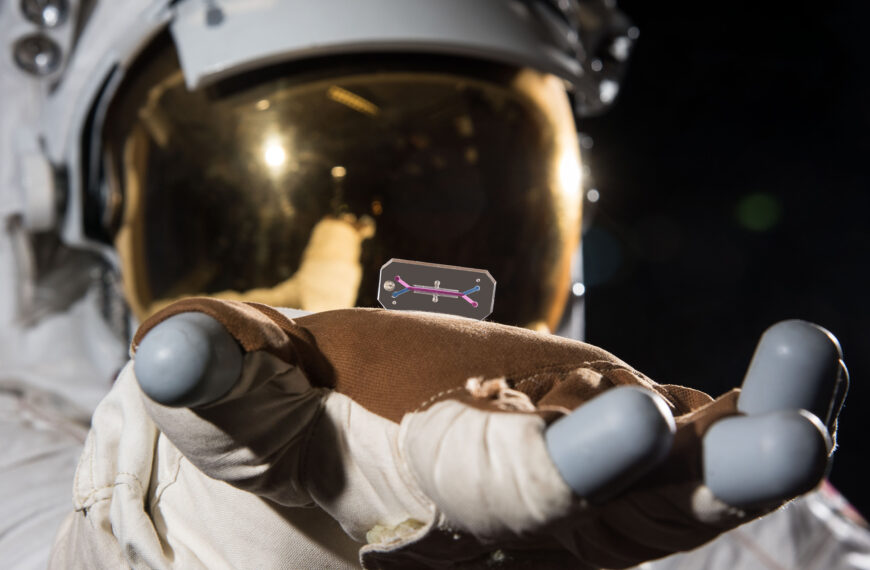
According to space publication Supercluster, the astronauts are carrying “completely functional” organ chips: organelles composed of bone marrow made from each astronauts’ cells.
In a highly complicated space mission, the justification for taking these organ chips is actually pretty straightforward. In leaving the protection of the Earth’s atmosphere, the four travelers expose themselves to heaps of solar and cosmic radiation. That radiation environment will present a unique window into the kind of dangers future astronauts will face in the dark reaches of space, so researchers are taking as many samples as they can get.
Mini organs aren’t new — scientists have been messing around with them since 2013 — but the decision to map them to their human counterparts in a space mission is.
“This is the first time we’re going to have crew with their matched organ chips,” David Chou, principal investigator of the chip experiment told SC. Having the humans and their micro organs side by side on the same voyage, he says, will enable scientists to compare the two biological materials against each other.
By using bone marrow cells — which are particularly vulnerable to radiation — to produce the chips, researchers are “maximizing the chance that we’ll see biologic differences, as opposed to modeling the skin or something else,” Chuo said.
For good measure, NASA also kicked duplicates of the astronauts’ organ chips up to the International Space Station, in order to compare deep space radiation with low earth orbit radiation over the same period. While they may seem small — and they are, at about the size of a USB stick — data provided by the chips could offer a major leap in our understanding of how the human body reacts to deep space, and at minimal cost, not to mention risk to human beings.
“Being able to understand how a broader representation of the public would respond to spaceflight is something you could do with organ chips much more cost-effectively,” Chou told SC. “You can make hundreds of these and send them up.”
More on NASA: Scientists Investigating Whether Object NASA Is Approaching Is Core of Destroyed Planet
The post The Moon Astronauts Brought Along USB Stick-Sized Living Samples of Their Own Tissue appeared first on Futurism.