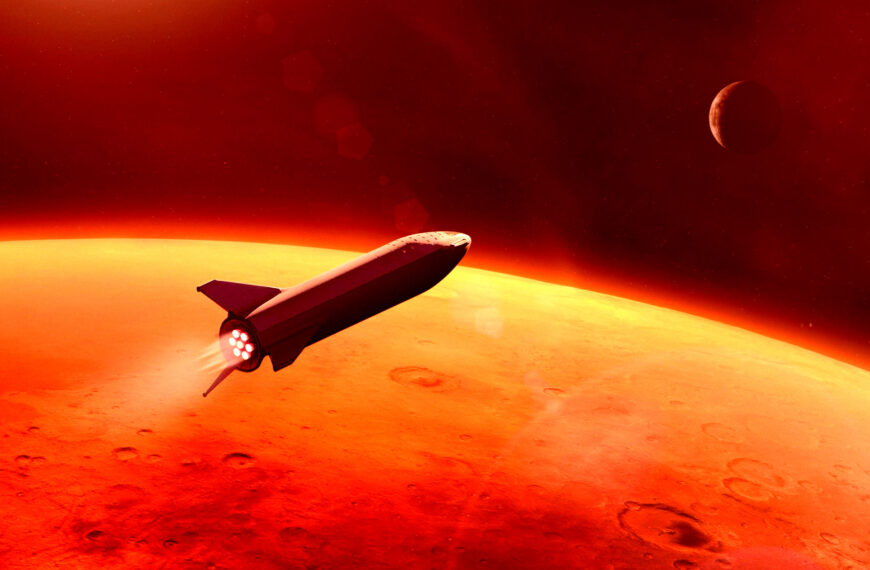
It takes an average of 12.5 minutes for light to cover the distance between the Earth and Mars.
Using currently available propulsion methods — and at a time when both planets’ orbits align perfectly, a “Mars opposition” that only happens every 26 months or so — traveling to the Red Planet could still take anywhere from five to 11 months.
But according to a new study published in the journal Acta Astronautica, there might be a way to cut the journey down significantly. Author Marcelo de Oliveira Souza, a cosmologist at the State University of Northern Rio de Janeiro in Brazil, considered the trajectory of asteroids, calculating a perfectly optimized route that he says could bring a round trip to Mars down to just 153 days.
He examined the flight path of asteroid 2001 CA21, which crossed the orbits of both Earth and Mars at a steady five-degree tilt. He then calculated this journey for the upcoming Mars oppositions over the next five years, concluding that in 2031, the planets align so perfectly that it “supports two complete sub-year round-trip missions consistent with the CA21-anchored plane.”
“The 2031 opposition emerges as uniquely favorable under the CA21-plane constraint, yielding two outbound Earth to Mars trajectories (33 and 56 days) and corresponding dynamically consistent return legs forming complete round-trip architectures of approximately 153 and 226 days total duration,” the paper reads.
Naturally, there are plenty of other major factors that will determine how long astronauts will have to spend to get to Mars, from propulsion methods and fuel capacity to the total mass of the payload.
Despite decades of extensive research, covering the average distance of 140 million miles — orders of magnitude farther than the Moon — with a human crew remains a distant goal. That’s not to mention the need to find shelter until the next Mars opposition, to ensure that the crew can make it back to Earth in one piece.
Yet as the latest paper suggests, even something as simple as the orbital plane of an asteroid could allow us to optimize our journeys there — a glimmer of hope that our first in-person visit isn’t quite as distant as it may seem.
More on trips to Mars: Scientists Puzzled by Huge Shadowy Blight Spreading Across Surface of Mars
The post There’s a Hidden Shortcut to Mars, Scientific Paper Finds appeared first on Futurism.