
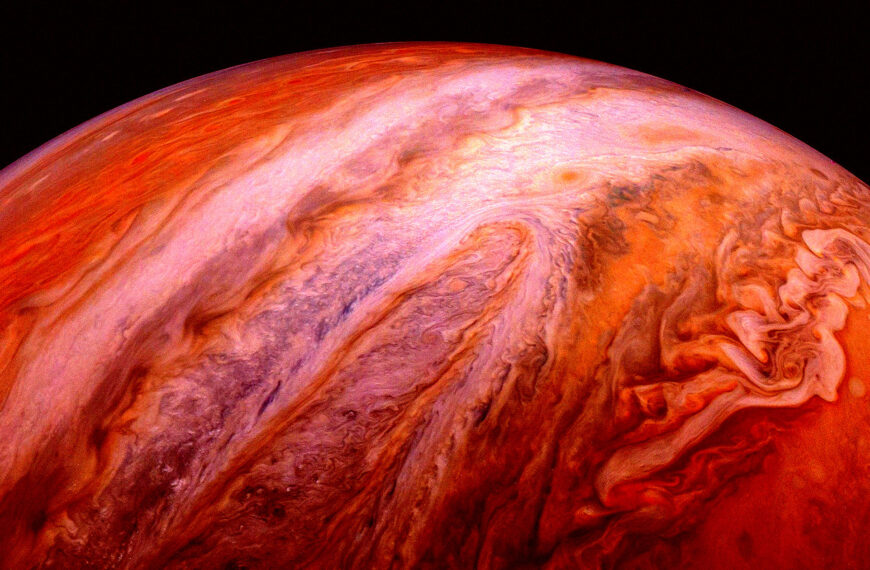
The enormous storms of impenetrable clouds covering Jupiter’s surface make it nearly impossible for us to get a glimpse of what lies below. Any spacecraft attempting to get a closer look would be vaporized, melted, or crushed if it attempted to sail through. NASA’s Galileo spacecraft, for instance, went dark almost immediately when it intentionally plunged into Jupiter’s atmosphere back in 2003.
While Jupiter — a giant ball of swirling gases and liquids — isn’t believed to have a true surface, scientists have been trying to get a better sense of its layers. Now, using data from NASA’s Juno and Galileo missions, a team of scientists at the space agency’s Jet Propulsion Laboratory and the University of Chicago have created a highly detailed computational model of Jupiter’s atmosphere.
And as detailed in a new paper, published in The Planetary Science Journal last month, they found something surprising down there: Jupiter appears to contain one-and-a-half times as much oxygen as the Sun — far more than previous estimates, which suggested it was only a third as much oxygen.
The findings also support the prevailing theory that Jupiter formed by accreting icy material billions of years ago near or past the “frost line,” as Space.com points out, meaning the distance from the Sun where temperatures are low enough for ammonia, methane, and water ice to form. (Whether the planet formed in its current orbit or much further away from the Sun before migrating to its current position over billions of years remains a topic of debate.)
Much of the oxygen is tied up in water as well, which changes its behavior drastically depending on temperature, further complicating our efforts to map out Jupiter’s layers.
The researchers’ computational model takes into account both the chemical reactions taking place — from extremely hot metal molecules deep inside the core and much cooler regions in its atmosphere — and the movement of gases, clouds and droplets.
“You need both,” said lead author and UChicago postdoctoral researcher Jeehyun Yang in a statement. “Chemistry is important but doesn’t include water droplets or cloud behavior. Hydrodynamics alone simplifies the chemistry too much. So, it’s important to bring them together.”
Their model suggests that gases move far more slowly through Jupiter’s atmosphere than previously thought.
“Our model suggests the diffusion would have to be 35 to 40 times slower compared to what the standard assumption has been,” Yang explained. “Instead of moving through an atmospheric layer in hours, a single molecule might take several weeks.”
It’s only one small part of a much larger mystery surrounding our solar system’s largest planet — and its more-than-intriguing collection of moons. The angry gas giant of swirling gases continues to baffle even top scientists.
“It really shows how much we still have to learn about planets, even in our own solar system,” Yang said.
More on Jupiter’s moons: NASA Says Europa Is Covered by a Thick Icy Shell
The post There’s Something Hiding Under Jupiter’s Clouds, Scientists Find appeared first on Futurism.