
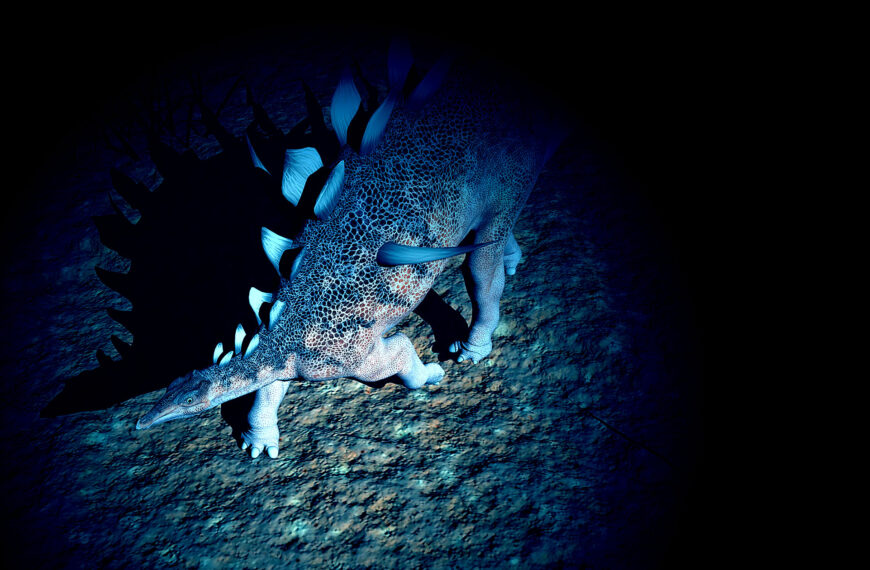
Roughly 66 million years ago, scientists believe an enormous meteor, dubbed Chicxulub, smashed into the Earth in an extinction-level event that wiped out 75 percent of life, including the vast majority of dinosaurs.
That means if aliens were to exist, and they were located some 66 million light-years from Earth, they’d theoretically still be able to see dinosaurs roaming the surface of our planet, since that’s how long it would take for light to travel such a distance through space.
But as astronomer and science communicator Phil Plait explored in a column for Scientific American, being able to spot the Earth, let alone any signs of life on our planet, would require an enormous telescope — to put it lightly.
“I’ve thought of it myself but never worked out the math — except to think, ‘Probably pretty big,’ which turns out to dramatically underestimate the actual answer,” he wrote. “But what’s really lovely is that grappling with this admittedly bizarre thought experiment has some real-life implications for the future of the science.”
According to Plait’s back-of-the-envelope calculations, which assumed a Tyrannosaurus rex measuring 33 feet long, the dinosaur would have an “apparent size of about 10-21 degrees.”
Using Dawes’s limit, a formula defining the maximum theoretical resolving power of a telescope, Plait found that such a telescope would need a mirror 3.4 light-years across — which, as he admitted, “would make for, um, a mighty big telescope.”
“That’s a mirror that would span three-quarters the distance to Alpha Centauri!” he added, referring to the closest star system to the solar system. At a thickness of just one millimeter, the mass of such a mirror would be “more than 100 million times the mass of Earth,” Plait calculated.
Of course, a highly advanced extraterrestrial civilization millions of light-years away may resort to other techniques, like an array of much smaller telescopes known as an interferometer, to mimic a much larger single telescope — not unlike the Event Horizon Telescope, which was used to study the suspected supermassive black hole at the center of the Milky Way.
Even then, “we’d still be talking about a billion trillion metric tons of mirror — a decent fraction of the mass of Earth,” Plait wrote.
The aliens would also need to find a way to move it all, track the Earth over time, and account for the movement of our galaxy.
“From 66 million light-years away, a T. rex is pretty faint; at that distance, even the Sun would be too faint to see using something like the Hubble Space Telescope,” Plait explained.
Thanks to NASA’s James Webb, we’ve been able to peer into the farthest visible reaches of space, which date to just hundreds of millions of years after the Big Bang 13 billion years ago. While that’s much further than 66 million light-years, we’re not even close to achieving the resolution to make out anything beyond entire galaxy clusters appearing like faint dots in observations.
Nonetheless, while Plait admitted the question of whether aliens at such a distance would be able to spot dinosaurs was “somewhat whimsical and fun to fiddle with,” the implications are certainly real.
Even to resolve clouds on exoplanets ten light-years away would require a “telescope array that stretched a few hundred kilometers across.”
“We aren’t ready to build that now, but in a few decades, perhaps,” Plait concluded. “How amazing would it be to see continents on a planet in another star system?”
More on dinosaurs: A Dinosaur Appears to Have Died on the Exact Spot They Later Built a Dinosaur Museum, Burying Its Fossil Underneath It
The post This Is How Big a Telescope Aliens Would Need to See Dinosaurs on Earth appeared first on Futurism.