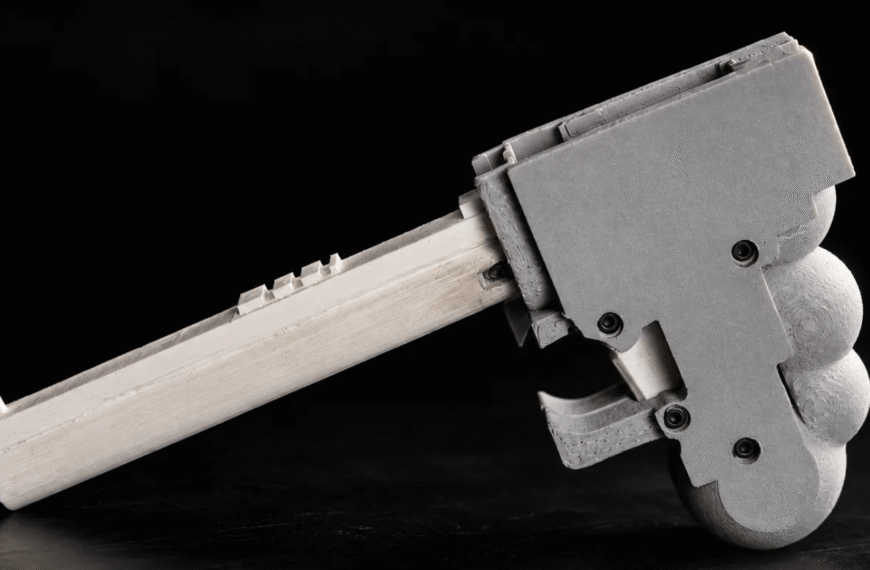

We can think of no possible way that a newly invented invisible drone can be used nefariously.
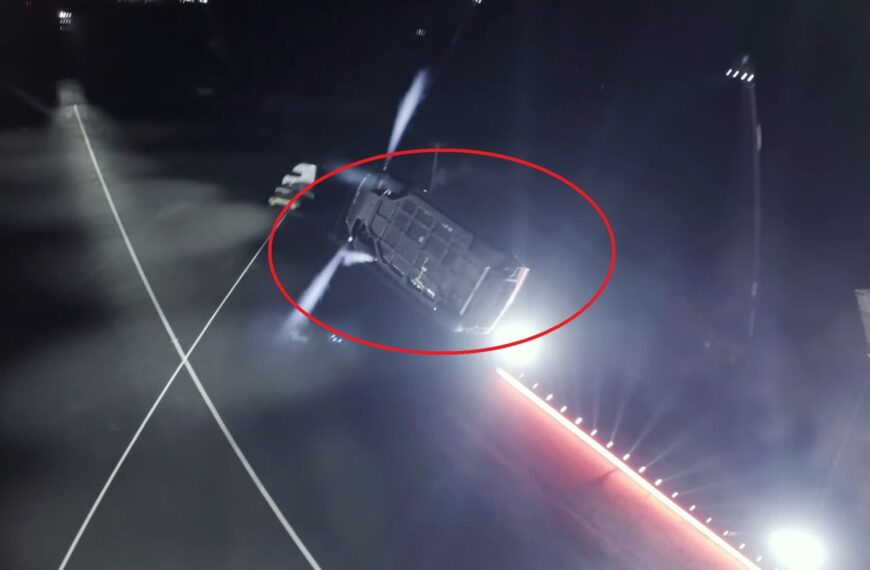
Rather than relying on camouflage, the flying gizmo created by researchers at Northwestern University exploits the motion blur effect in our fallible human vision to almost disappear by spinning at an absurd 25 times per second.
This is too quick for us and many animals to see clearly, becoming a gossamer smear that blends into the background, like the way the blades of a helicopter do, only more extreme.
One day, this type of design could be used for completely peaceful pursuits, the researchers say — like observing wildlife, of course.
“Most efforts to hide drones focus on making them look like their surroundings,” Michael Rubenstein, an associate professor of computer science and mechanical engineering at Northwestern who led the research, said in a statement about the work.
“Instead, we asked whether we could design the drone itself around the way humans perceive motion,” he added. “This idea of low visibility through persistent motion is something few people have explored.”
To create the drone, dubbed “Phantom Twist,” the team used a computational model to churn out around 20,000 different drone designs, then used AI and optimization algorithms to repeatedly rearrange how its major parts, like their motor and propeller, were configured.
Then they took the best configurations and used a model that simulates human perception to quantify how visible each design appeared. The least visible designs were chosen to be further rearranged with the optimization algorithm, until landing on the blurriest candidate of them all.
“The design process was fully automated,” Rubenstein said. “Then, when we were confident that a drone met all our criteria, we built it.”
Their research, detailed in a paper awaiting peer review, was presented at the Robotics: Science and Systems 2026 conference in Sydney this month.
It’s not the first spinning drone, but it is the first that’s been optimized to be effectively invisible to the human eye. Its major components are carefully spaced enough from each other to never become a distinct shape when viewed from any angle while spinning — all while being capable of stable flight.
According to the researcher’s visibility model, this allows the Phantom Twist to be about ten times less visually perceptible than a conventional quadcopter drone. Impressive footage certainly bears this out: after the drone gets up to full speed, it almost looks like the ghost of a tiny UFO.
The drone is quite noisy, however. If something like it is going to be used to observe wildlife one day, it’ll have to be vastly quieter. Until then, if these faint apparitions are ever turned on humans, at least we’ll be able to hear them coming.
More on robots: Autonomous Robots Confirmed to Have Killed Human Soldiers
The post We’re Admittedly Terrified That They’ve Now Invented Invisible Drones appeared first on Futurism.