
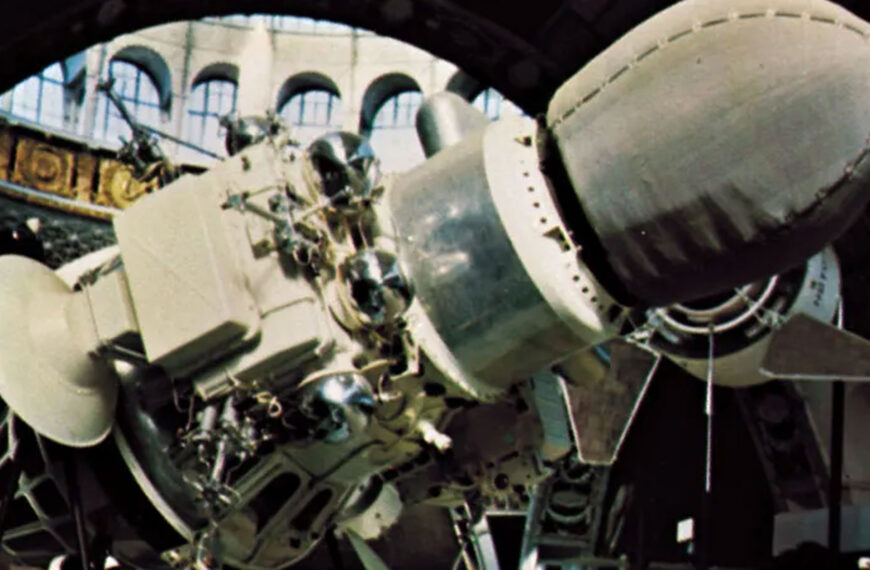
In 1966, three years before the first humans walked on the Moon, the Soviet Union landed a small, spherical probe, dubbed Luna 9, on the lunar surface.
It was a historic moment, with the spacecraft becoming the first to achieve a soft landing and return the first photo from the surface of another celestial body: a high-contrast, black-and-white image of a rugged, rocky landscape.
Its actual whereabouts on the Moon, though, soon become a major point of contention. As the New York Times reports, two groups of scientists have now come forward saying they’ve found traces of the lost Soviet lander. However, the two groups don’t agree on where Luna 9 is hidden.
What makes it particularly difficult to spot is its diminutive size. Its spherical core stage measures a mere two feet across, making it roughly the size of a beach ball.
As Mark Robinson, principal investigator of the camera attached to NASA’s Lunar Reconnaissance Orbiter, told the NYT that Luna 9 is simply too small for the satellite to spot and confirm.
“You can stare at an image, and maybe that’s it, but you can’t really know for sure,” he said.
In a years-long effort to track down the historic relic, science communicator Vitaly Egorov turned to crowdsourcing to scan a 62-mile-wide region on the Moon for any unusual signs.
Egorov claims to have found Luna 9’s final resting place, after studying the horizon features in the grainy, black-and-white image the probe sent back to Earth 60 years ago.
He told the NYT that he’s “fairly confident” but admitted that he doesn’t “exclude an error of several meters.”
Fortunately, India’s space agency has agreed to use its higher-resolution satellite, Chandrayaan-2, to have a closer look in March.
Not everybody agrees with Egorov’s conclusion. Scientists at the University College London determined a different landing site, as detailed in a paper published in the journal npj Space Exploration last month.
The team came up with a machine-learning algorithm, inventively called “You-Only-Look-Once–Extraterrestrial Artefact” (YOLO-ETA), to train an AI on existing NASA findings of past landing sites on the Moon.
One spot, a bright pixel near two darker spots that could be Luna 9’s protective shells that it used to soften its landing, could be its final resting place, the University College London team claims.
For now, scientists await word from India’s Chandrayaan-2 team, which could soon shed more light on the matter — a treasure hunt over half a century in the making.
To some, it’s only a matter of time until we confirm where Luna 9 — and its twin, Luna 13 — have been resting for decades.
“It’s just a matter of placing bigger and better cameras into orbit around the moon,” Russian spaceflight expert and space journalist Anatoly Zak told NYT. “In our lifetimes, we probably will see those sites.”
More on spotting objects on the Moon: NASA Spots Object Speeding Around the Moon
The post Scientists Spot Signs of Derelict Soviet Moon Lander on Lunar Surface appeared first on Futurism.