
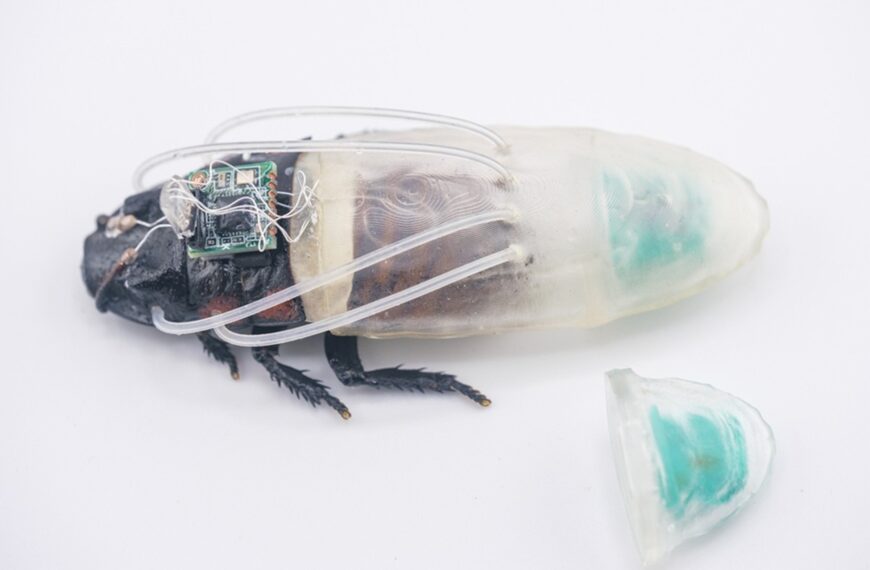
Scientists turned a bunch of cockroaches into remote-controllable cyborgs — and then built them little scuba suits so they can swim underwater, transforming them into powerful amphibian troopers.
Rest assured, they (the scientists, not the roaches) aren’t intent on world domination. Instead, they propose that one day a swarm of these biological drones could be used to poke around dangerous environments, such as disaster areas — or, even more ambitiously, other planets. They published a new study about the project this week in the journal Nature Communications.
“The ultimate goal is to [take this technology to] space,” study coauthor Hirotaka Sato Nanyang Technological University in Singapore, told New Scientist. “It’s kind of one step, one big step, towards space suits for cyborg insects. Exploration over the Mars surface, for example.”
Roboticists love roaches. The bugs’ cybernetic potential is so well studied by now that you can easily go and buy a DIY cyborg roach kit online. Roaches are also infamously hard to kill, and Sato’s team chose an especially hardy species called the Madagascar cockroach, which lives up to five years and are about the size of a human finger. Those are desirable traits to have, if they’re to survive on their own for extended periods in harsh environments.
Still, as resilient as roaches are, they’re not amphibious, posing a major obstacle for their usefulness in disaster areas, which are commonly flooded.
To address that, the team designed and 3D printed oxygen-providing suits that cover the pores that roaches breathe through, which are called spiracles. The spiracles near the bug’s legs are connected to hoses so the main body of the suit wouldn’t restrict leg movement. Rather than storing oxygen in a tank, as New Scientist notes, the suit is instead filled with a mixture of hydrogen peroxide and manganese dioxide, which over time decompose to produce oxygen. The researchers also decided to implant the controller chip and its tiny battery unit inside the roach’s body, after finding that having them in a backpack attached to the roaches’ exterior impeded their mobility.
In tests, the scuba-diving roaches were able to walk underwater for up to three hours at a time, moving nearly as fast as they did on land. The roaches experienced no adverse effects, and appeared healthy days after their aquatic expeditions.
Cyborg insects may not provide the same degree of control as mechanical robots do, but they come with other advantages. They’re cheaper, and crucially, are energy efficient. One day, if you’re ever stranded somewhere and in need of rescue, your first glimmer of hope may be a kitted-out bug crawling into view.
More on robots: Behold! Duke Scientists Build Biblically Accurate Angel Robot
The post Swarm of Cyborg Remote Controlled Cockroaches Gains New Power appeared first on Futurism.