Elon Musk’s promises tend to follow a formula. They involve a number ending in “-illion,” pertaining to something which will be built or deployed, and which will be accomplished within a number of years that is decidedly not an “-illion” — and that’s before we get into the continual revision as timelines slip and customers patience wears thin.
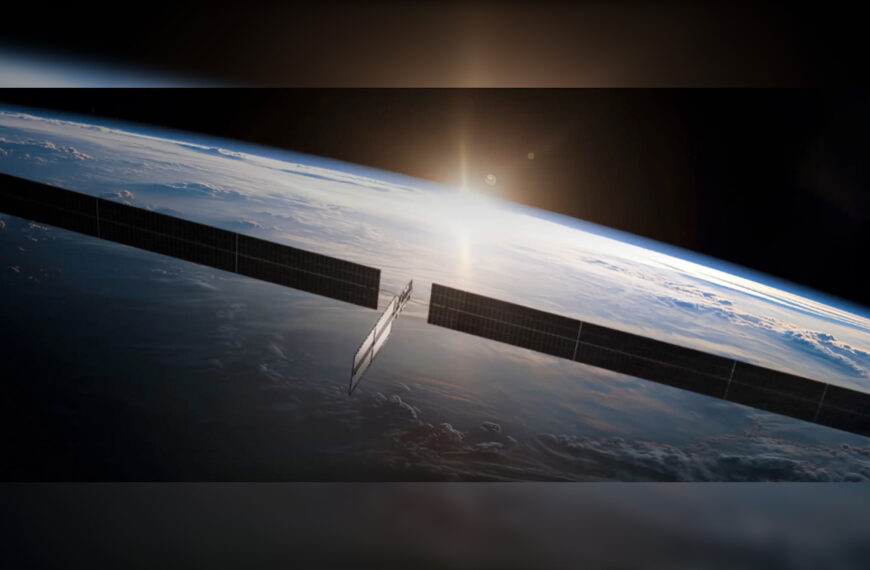
And now, right on cue: an ambitious new plan for orbital data centers, which Musk envisions as a massive conglomeration of also-massive solar-powered satellites. Musk hopes to deploy up to one million of these satellites to provide a virtually unlimited source of computing power for AI, and told employees that generating AI compute in space will be cheaper than terrestrial data centers in just two to three years.
Further beggaring belief is the size of each of these satellites, revealed in a presentation Musk gave this Sunday which provided a more detailed look at his orbital data center roadmap.
Based on a size comparison rendering he provided and highlighted by PCMag, a “mini” version of the AI satellite will dwarf even SpaceX’s Starship rocket, the largest rocket in the world at about 408 feet tall. That also means it’s considerably longer than the International Space Station, at 358 feet. Its colossal size mostly comes from its solar arrays, which will harness the energy needed for 100 kilowatts of computing, Musk says.
No precise dimensions were provided, and Musk said this was just a “rough approximation” of its final size, but it speaks to the absurd ambition of his vision. And that it’s the “mini” version hints he wants to deploy even larger ones in the future.
From the moment Musk first unveiled these plans last month, astronomers feared that the enormous satellite constellations would block observations of deep space. Now, with the newly revealed size estimates, the threat may be even worse than feared.
“We thought the size we assumed was ridiculous, but this graphic shows that we actually underestimated what SpaceX is planning to do,” Samantha Lawler, a University of Regina astronomer who co-wrote a recent essay warning about the constellation’s impact on astronomy, told PCMag.
The terrestrial logistics needed to get this, well, off the ground, are equally mind-blowing. To provide the AI chips for the data centers and other AI ventures, Musk announced a new facility, called “Terafab,” to churn out the uber-advanced processors. It will cost $20 billion to build, he estimated, and will produce up to 200 billion — there’s that numerical suffix again — AI or memory chips every year.
“We either build the Terafab, or we don’t have the chips,” Musk said.
Layering one business grift on top of another, he also claimed that millions of Tesla Optimus robots will help maintain the facility — which is just a fraction of the billions of Optimus units he says Tesla will produce each year thanks to Terafab’s chip output.
So, what’s the damage? Ars Technica estimated that the bare-bones cost of deploying 1 million satellites would be more than a trillion dollars, which is almost as much as SpaceX’s estimated valuation ahead of an anticipated IPO. When your a conservative estimate of your bill is nearly the same as a made-up and inflated number for how much your company is worth, you’ve got problems.
More on SpaceX: SpaceX’s One Million Orbital Data Centers Would Be Debilitating for Astronomy Research, Scientists Say
The post Elon Musk’s Orbital Data Centers Are Staggeringly Huge appeared first on Futurism.